SMOKE DETECTION GUIDE
How Much Smoke Will Trigger a Smoke Detector? Understanding Alarm Thresholds
For purchasing managers, fire safety engineers, and OEM project teams, one practical question often influences detector selection and system design: How much smoke is required before a smoke alarm enters alarm state? In commercial fire detection systems, there is no single smoke level that applies to every detector. Detector response is shaped by sensing technology, sensitivity settings, airflow behavior, and installation environment. This is why alarm performance can vary between applications even when smoke conditions appear similar.
— The Ultimate Solution for Smoke Alarm Sensitivity in B2B Procurement and OEM Projects
For commercial buildings and OEM fire alarm projects, the key question is rarely “how much smoke” exists in the room. What matters more is the smoke obscuration level at which a detector enters alarm state—and whether that sensitivity can remain stable, controllable, and maintainable throughout the product lifecycle.
This is one reason many modern projects are moving toward photoelectric, adjustable-sensitivity, and intelligent compensation designs. From an engineering and procurement standpoint, long-term sensitivity management often has greater project value than a detector that simply alarms as early as possible.

How Much Smoke Triggers a Smoke Detector?
Smoke detectors are not triggered by a fixed “amount of smoke” measured by weight or visible volume. In commercial fire detection systems, smoke concentration is typically evaluated using Obscuration—a measurement describing how smoke particles reduce light transmission through air. Obscuration is commonly expressed as: % obs/m (percent obscuration per meter). From an engineering perspective, obscuration provides a more practical reference for detector sensitivity than simply estimating how much smoke is present. Lower obscuration thresholds generally indicate higher detector sensitivity, while higher thresholds require greater smoke density before alarm activation.
The design of commercial systems is, in essence, a balancing act between early warning capability and false alarm control. Different standards systems employ different evaluation methodologies, including UL 217 (Residential — USA), UL 268 (Commercial Detectors), EN 14604 (Residential — Europe), and AS 3786 (Residential — Australia). The primary focus of these standards is not on a fixed quantity of smoke, but rather on detection reliability, response time, resistance to false alarms, and long-term stability.

Different standards systems employ different evaluation methodologies. The primary focus is on detection reliability, response time, and long-term stability—not a fixed quantity of smoke.
Smoke Quantity vs Smoke Obscuration
Smoke detectors do not measure smoke by weight or visible volume. Commercial systems evaluate smoke density through obscuration, which describes how smoke reduces light transmission through air. Because smoke composition, airflow, and particle size vary, obscuration provides a more reliable engineering reference than simply estimating “how much smoke” is present.
Need Help Selecting the Right Smoke Detector Sensitivity?
Detector sensitivity affects more than alarm speed alone. Airflow conditions, application environment, and false alarm expectations all influence system performance. Talk with our engineering team about sensitivity planning for commercial or OEM fire alarm projects.
Understanding Smoke Detector Sensitivity Levels
What Does Obscuration Mean?
Obscuration refers to the percentage of light blocked by smoke particles over a defined distance, commonly expressed as % obs/m. Lower obscuration thresholds indicate higher detector sensitivity, while higher thresholds generally require greater smoke density before alarm activation. This measurement is widely used in commercial smoke detection design and sensitivity evaluation.
Industry Standard: Sensitivity is typically described in terms of Obscuration (the rate of light reduction). It measures “how opaque” the air becomes due to the presence of smoke. Commercial-grade smoke detection systems typically define multiple sensitivity levels.

Typical Commercial Sensitivity Settings
Sensitivity | Obscuration | Application Characteristics |
|---|---|---|
High Sensitivity | 18% | Early warning; suitable for clean environments |
Medium-High Sensitivity | 25% | Typical office and commercial environments |
Standard Sensitivity | 35% | Balances alarm detection with false alarm prevention |
Low Sensitivity | 50% | Environments with high dust levels or complex airflow |
Note: The sensitivity references of 18%, 25%, 35%, and 50% should not be interpreted as globally fixed regulatory alarm thresholds. In commercial fire detection practice, these values are more commonly used to describe different sensitivity strategies applied across varying risk environments. Sensitivity settings are usually determined as part of the overall fire protection design, rather than applying a single, uniform threshold across the entire building.
18% Obscuration
Features: Early warning and rapid response. Suitable for data centers, hotel guest rooms, hospital corridors, equipment rooms, and critical infrastructure. However, the risk of false alarms is also higher.
25%–35% Obscuration
This represents the balanced range adopted in many OEM projects. It balances fire response sensitivity with false alarm control, results in a lower user complaint rate, and is better suited for mixed-use residential and commercial applications. Many mature solutions are designed based on an obscuration rate of approximately 25–35%.
50% Obscuration
Suitable for warehousing, industrial environments, and dusty environments. Features a high alarm threshold. Advantages: Fewer false alarms. Disadvantages: Response time may be slower.
Why Sensitivity Is a Design Decision, Not Just a Number
Commercial smoke detector sensitivity is not governed by one globally fixed threshold. In commercial projects, detector sensitivity is usually selected according to occupancy risk, airflow conditions, and nuisance alarm tolerance. The objective is rarely maximum sensitivity alone, but stable performance matched to real operating conditions.
Photoelectric vs Ionization Smoke Detectors
The triggering threshold of a smoke detector primarily depends on the detection technology employed.
Why Photoelectric Smoke Detectors Respond Faster to Smoldering Fires
Photoelectric smoke detectors’ key characteristics include: sensitivity to large smoke particles, rapid response to smoldering fires, and typically lower false alarm rates.
Typical Smoldering Scenarios
Common alarm thresholds for commercial photoelectric detectors range from approximately 0.5–3.0% obscuration/meter (% obs/m). Operating outside this range may result in excessive sensitivity causing frequent false alarms, or insufficient sensitivity causing delayed response to fires. Related sensitivity testing and range calibration are critical components of fire safety system maintenance.

Why Ionization Smoke Detectors Respond Faster to Flaming Fires
Ionization detectors utilize changes in ionization chamber current to detect minute combustion particles.
Key Characteristics
Typical Scenarios
Characteristics of such fires include large flames, rapid temperature rise, and abundance of fine particles. However, ionization detectors are typically more susceptible to interference from cooking smoke, kitchen fumes, and environmental particulates.
Why Many Commercial Projects Prefer Photoelectric Technology
While ionization detectors are suitable for certain combustion characteristics, some markets are gradually phasing them out. Modern commercial projects are increasingly favoring photoelectric detectors, dual-sensor detectors, and multi-sensor fusion systems in order to simultaneously cover the risks associated with both smoldering and flaming fires.
Explore Low False Alarm Photoelectric Smoke Detection Solutions
Photoelectric and adjustable-sensitivity technologies are increasingly used in commercial projects where stable performance and nuisance alarm control matter.
Evaluate commercial smoke detector solutions designed for lower false alarm risk and long-term reliability.

Modern commercial projects increasingly favor photoelectric technology due to its superior performance in detecting smoldering fires and lower false alarm rates.
Typical Commercial Photoelectric Sensitivity Ranges
Commercial photoelectric detector sensitivity commonly operates within application-specific ranges configured through detector design or control panel settings. Actual thresholds vary according to certification method, environmental conditions, and fire protection strategy. Sensitivity selection should therefore be reviewed together with airflow, occupancy risk, and false alarm expectations.
What Influences Photoelectric Detector Thresholds?
Photoelectric detector thresholds are influenced by chamber design, detector sensitivity configuration, airflow conditions, and certification requirements. Commercial systems should evaluate these factors together rather than relying on nominal sensitivity values alone.
Why Smoke Detector Sensitivity Drifts Over Time
Why does sensitivity vary within the same model? Many post-sales complaints do not stem from product failure but rather from environmental changes that have altered the product’s sensitivity. Many false alarms are not indicative of product quality issues, but rather of “sensitivity drift.” As a smoke detector progresses through its service life, its triggering threshold gradually deviates from its original design value.
Dust Accumulation (Dust Contamination)
This is the most common factor. Once dust enters the smoke chamber, it may increase the scattered light signal, trigger false smoke alarms, and cause premature alarms. The risk is particularly high in factories, warehouses, and areas adjacent to commercial kitchens.
Humidity and Condensation
High-humidity environments may alter the optical path, cause condensation, and trigger false alarms. Typical environments include underground spaces, laundry areas, and coastal projects.
Airflow Conditions
HVAC design directly impacts alarm performance. High-velocity airflow may dilute smoke, delay its entry into the detection chamber, and result in alarm lag. Therefore: Detector Performance = Product + Installation Location + Airflow Design.
Sensor Aging
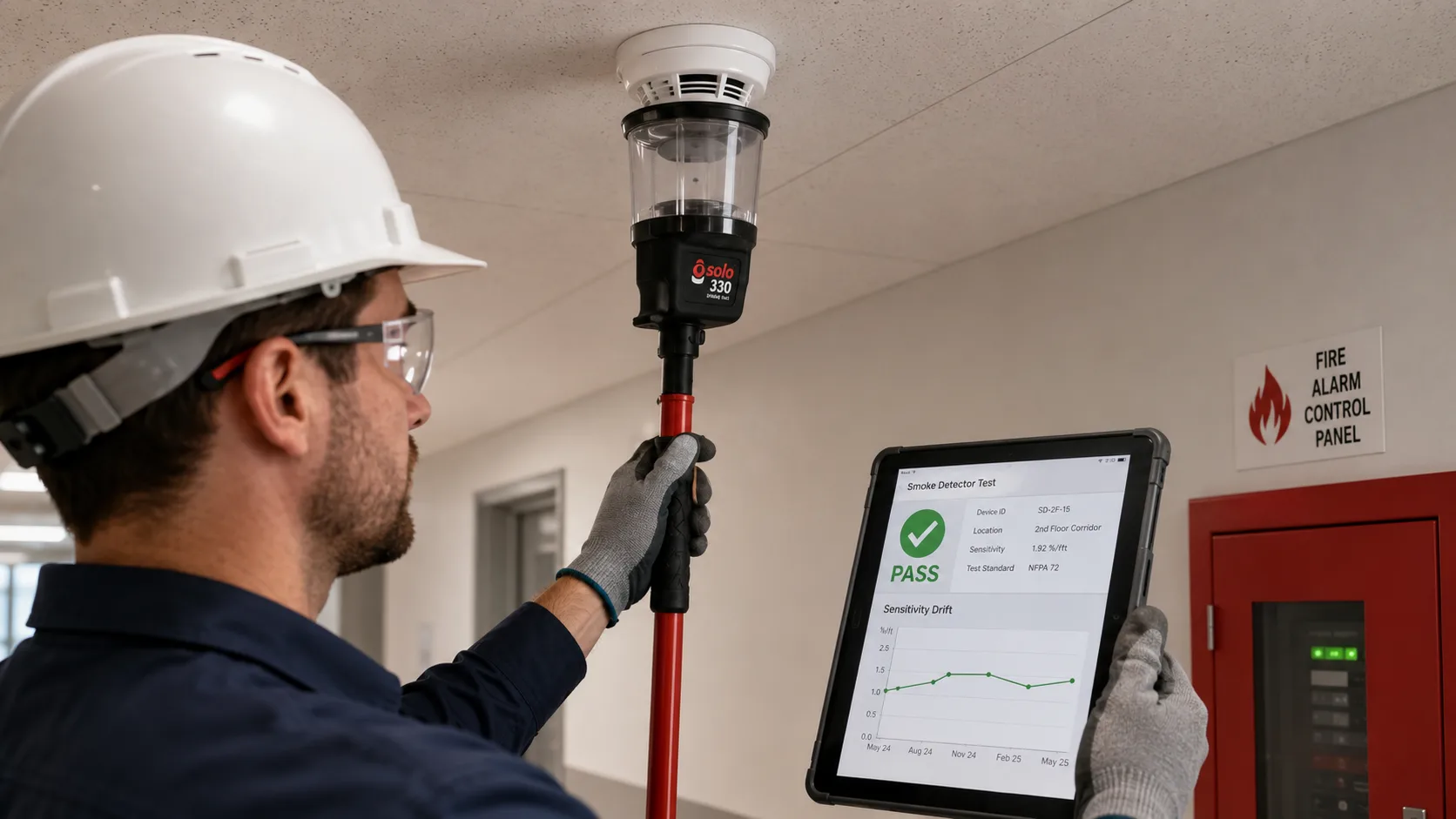
The aging of electronic components can lead to baseline drift, decreased sensitivity, and deteriorated response consistency. This is why commercial fire alarm systems must undergo Sensitivity Testing and establish a periodic maintenance regimen. The relevant maintenance protocols set forth by the NFPA emphasize continuous monitoring and drift management.
NFPA and Sensitivity Maintenance Expectations
NFPA maintenance guidance emphasizes ongoing inspection, sensitivity verification, and detector performance monitoring throughout the product lifecycle. For commercial facilities, long-term alarm reliability depends not only on initial calibration but also on periodic testing and drift management.
Can You Adjust Smoke Detector Sensitivity?
Fixed Sensitivity vs Adjustable Sensitivity
Yes, but this depends on the product grade. Standard residential alarms typically feature fixed sensitivity, whereas certain commercial models support multi-level sensitivity adjustment.
Common Sensitivity Adjustment Methods
Typical Applications
Application | Recommended Sensitivity Strategy |
|---|---|
Hotels | Medium-High Sensitivity |
Hospitals | High Sensitivity |
Factories | Medium-Low Sensitivity |
Areas Adjacent to Kitchens | Low Sensitivity |
Warehouses | Adjust Based on Airflow |
Some advanced systems also support Automatic Sensitivity Monitoring. They continuously monitor for detector sensitivity drift and automatically trigger an alert.

Automatic Drift Compensation and Smart Monitoring
Advanced commercial systems increasingly support automatic drift compensation and sensitivity monitoring. These functions help identify detector contamination and maintain stable alarm performance without requiring constant manual recalibration.
Why Adjustable Sensitivity Matters in OEM Projects
For OEM brands and engineering procurement, such features often translate to:

Commercial Detection Projects Focus on Controllable Sensitivity
In large-scale commercial or OEM projects, clients are concerned with more than just: “Can it trigger an alarm?” Rather, they ask: “Can it alarm reliably, minimize false alarms, and maintain long-term consistency?” This is precisely why an increasing number of commercial systems are adopting photoelectric technology, multi-level sensitivity settings, intelligent compensation algorithms, and environmentally adaptive designs.
For purchasing managers, false alarm rates, maintenance costs, and user complaints often have a greater impact on a project’s ROI than the speed of a single alarm response. In commercial projects, detector sensitivity is evaluated not only by fire response speed but also by maintenance stability and complaint management. Projects located near kitchens, HVAC zones, or industrial airflow conditions often prioritize controllable sensitivity over maximum sensitivity alone.
FAQ — Smoke Detector Alarm Thresholds
Planning an Adjustable-Sensitivity OEM Smoke Alarm Project?
Commercial OEM development often requires more than detector selection alone. Our engineering team supports multi-level sensitivity design, automatic drift compensation, low false alarm optimization, UL / EN / AS3786 compliance planning, and private-label OEM / ODM development.
Discuss your OEM smoke detection requirements with CFS engineers.
Commercial Smoke Detection Is About More Than Early Alarm
In commercial and OEM projects, detector performance is usually evaluated through long-term stability, controllable sensitivity, and false alarm management—not alarm speed alone. Whether your project involves commercial buildings, HVAC-sensitive environments, industrial facilities, or OEM / private-label development, our engineering team can help evaluate the right smoke detection strategy.
Talk with CFS fire protection engineers today about commercial smoke detector solutions and OEM development support.


