——How integrated smoke and temperature detection works, what OEM buyers should specify, and how to verify certification and mass-production consistency
For residential developers, fire safety brands, purchasing managers, and OEM/ODM clients, a combined smoke and heat alarm is not merely about housing a smoke alarm and a heat alarm in the same unit.
A true integrated product combines the following elements within a single housing, PCB, power system, and user interface:
Taking CFS’s SM11HR model as an example, the device uses a photoelectric detection chamber to detect smoke while simultaneously employing a thermistor to monitor ambient temperature changes. According to CFS specifications, this platform supports Zigbee or 433 MHz wireless interconnection—allowing for a network of up to 30 devices—and is powered by a 3V lithium battery.

For OEM buyers, the key question is not simply whether the alarm contains two sensors. The blog will explain how the smoke and temperature channels are processed, the alarm logic, the power budget, and certification for consistent mass production.
Quick Answer: What Is a Smoke and Heat Combination Alarm?
A Smoke and Heat Combination Alarm is a single alarm device that integrates smoke detection and heat detection inside the same housing.

Its core structure typically comprises two detection channels:
A photoelectric smoke detection chamber identifies smoke by detecting the scattering of infrared light caused by smoke particles.
Thermistors exhibit varying resistance values under different ambient temperatures, which are converted into processable electrical signals with varying voltages.
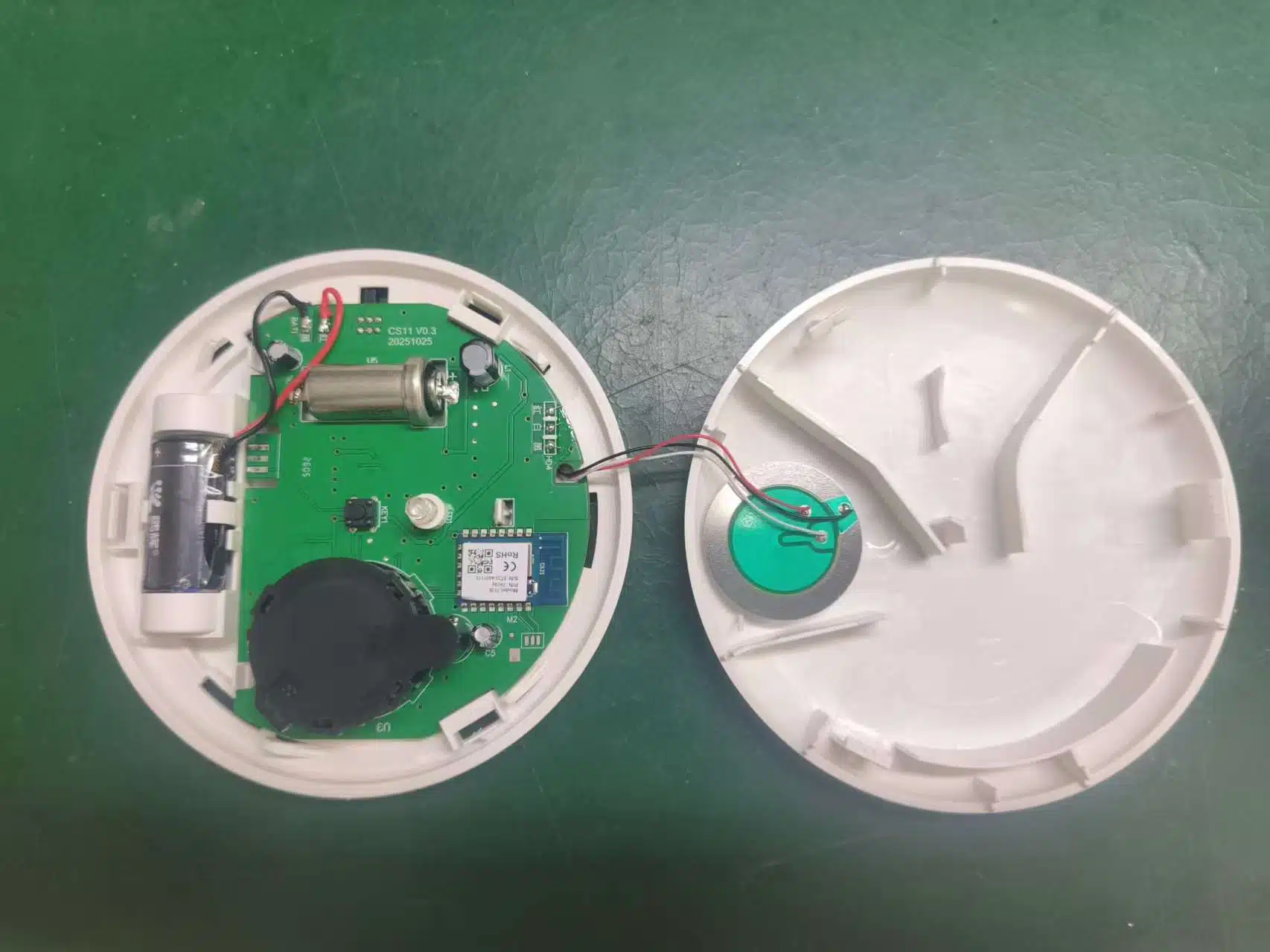
Each channel independently acquires signals, which the MCU then processes for decision-making, status management, and alarm control.
Please note the following distinction: A combined smoke and heat detector alarm ≠ a smoke alarm network + a heat alarm network
Although the SM11HR supports wireless interconnection, the term “Smoke + Heat Combination” primarily refers to its standalone detection architecture, while wireless interconnection is a separate functional layer.
For OEM buyers: “combination” defines what the individual alarm detects, while “interlinked” defines how multiple alarms communicate.
Smoke + Heat Combination Alarm vs Multi-Sensor Alarm vs Interlinked Alarm
You may be confused about the three items, but they are different.
Term | What It Describes | Typical Architecture |
|---|---|---|
Smoke + Heat Combination Alarm | Multiple detection technologies in one alarm | Smoke sensing + temperature sensing in one housing |
Multi-Sensor Alarm | Multiple sensing parameters used for detection or decision-making | Two or more sensor inputs processed by electronics and firmware |
Interlinked Alarm | Communication between multiple alarm units | RF, Zigbee, hardwired or other communication network |

Smoke + Heat Combination Alarm
A smoke + heat combination alarm integrates smoke detection and temperature detection into a single physical product.
For example, the CFS SM11HR combines a photoelectric smoke detection chamber with electronic temperature detection within one housing. The two sensing channels are processed by the product’s electronics and alarm logic.
In this case, “combination” describes the detection architecture of the individual alarm.
Multi-Sensor Alarm
The term multi-sensor alarm is broader.
A multi-sensor product may use multiple physical parameters to improve detection or alarm decision-making. Depending on the product design, these parameters may include smoke, temperature, carbon monoxide or other sensing inputs.
Therefore:
Multi-Sensor Alarm is a broader product category, while Smoke + Heat Combination Alarm describes a specific combination of detection functions.
The presence of multiple sensors does not by itself determine the alarm algorithm or certification scope. These need to be evaluated at the complete product level.
Interlinked Alarm
Interlinked describes communication between multiple alarm devices rather than the number of sensors inside one device.
For example:
Alarm A → Wireless Communication → Alarm B → Alarm C
When one alarm detects a fire condition, it can transmit an alarm signal to other compatible units.
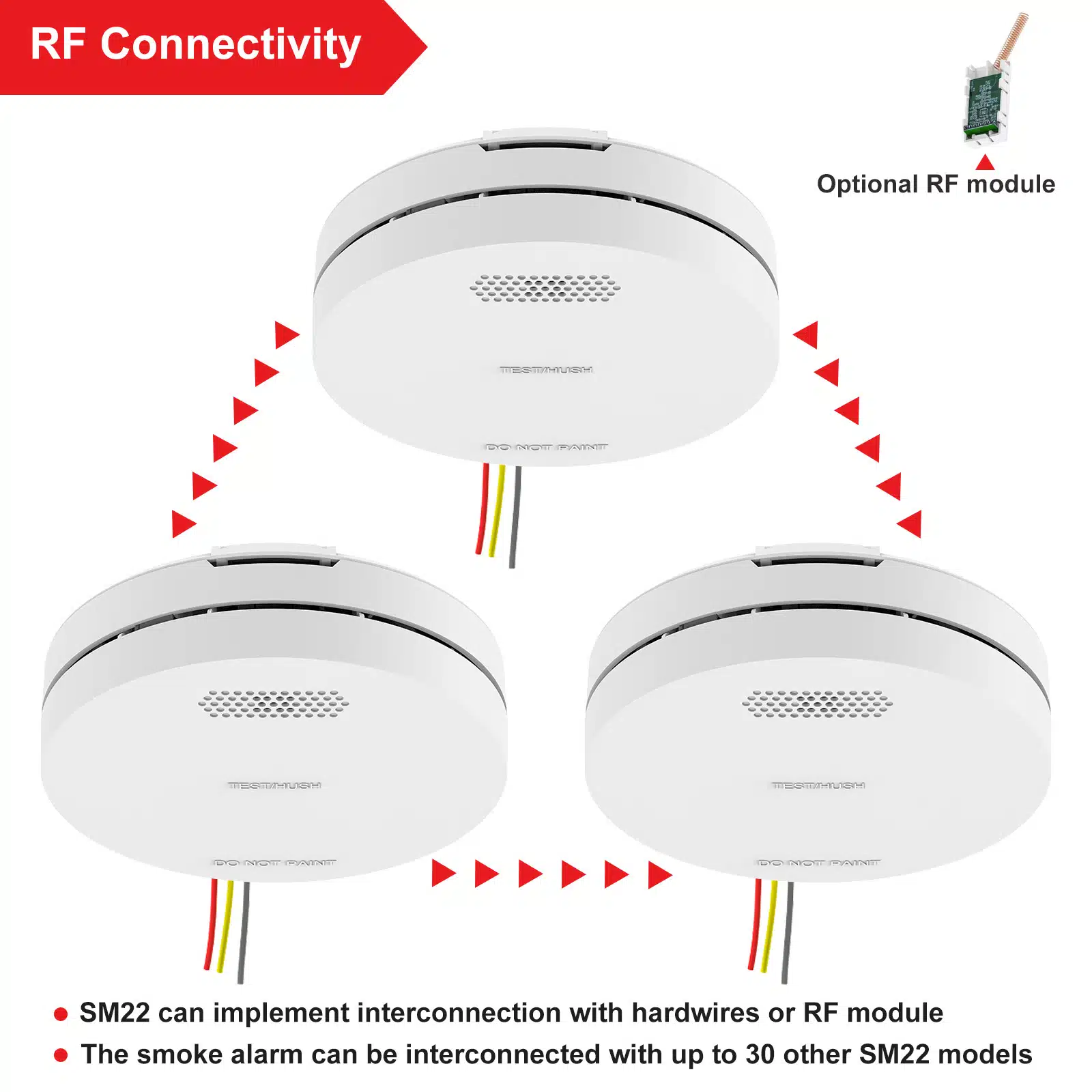
The communication layer may use RF, Zigbee, hardwired communication or another defined protocol, depending on the product architecture.
One Product Can Have All Three Characteristics
A single alarm can simultaneously be:
Smoke + Heat Combination Alarm + Multi-Sensor Alarm + Interlinked Alarm
These terms describe different engineering layers:
For OEM buyers, separating these three concepts is important when defining the product specification, certification scope and interconnection requirements.
A Practical Example: CFS SM11HR
The smoke heat combo alarm SM11HR can be understood at three different levels:
Therefore, “Smoke + Heat Combination” does not mean that separate smoke and heat alarms have been combined into a network. It describes the integration of two detection functions within one product.
What Does a Smoke and Heat Combination Alarm Detect?
Smoke and heat are two different physical fire indicators.
Detection Channel | Detection Target | Main Component |
|---|---|---|
Smoke Detection | Airborne smoke particles | Photoelectric chamber |
Heat Detection | Ambient temperature / temperature change | Thermistor |
Signal Processing | Sensor output | MCU |
Notification | Fire warning | Buzzer + LED |
Optional Networking | Other compatible alarms | RF / Zigbee |
The value of this design lies in its ability to monitor two distinct physical parameters with a single product.
Smoke Detection
In standby mode, IRED emits infrared light, which is refracted by the chamber. The photodetector receives a weak infrared signal, and due to the photoelectric effect, a current is generated in the receiver. This current is amplified by the IC’s internal amplifier and converted into a chamber output voltage.
When smoke is present, the light signal is amplified by reflection and refraction off smoke particles, increasing the conversion current and the chamber output voltage. When the chamber output voltage reaches the alarm threshold, the buzzer sounds.
Heat Detection
Heat detection monitors ambient temperature and temperature change as an additional fire-detection parameter. Unlike the photoelectric channel, it does not respond directly to airborne smoke particles.
However, the presence of a heat channel does not automatically make a smoke + heat combination alarm suitable for locations where smoke alarms may experience nuisance alarms from cooking fumes, steam, dust or aerosols. Installation suitability should still be evaluated against the applicable product standard, certification scope and local installation requirements.
However, one should not simply conclude that: Heat detection is always better than smoke detection.
The two technologies address different issues.
However, this does not imply that both sensors must trigger an alarm simultaneously.
In a mature product design, the smoke and temperature channels can perform detection and status assessment independently, with software defining distinct logic for alarms, faults, testing, and muting.
How Does a Smoke and Heat Combination Alarm Work?

Step 1: Smoke Enters the Optical Chamber
When smoke particles are present in the air, they enter the optical detection chamber through the alarm’s smoke intake structure.
Photoelectric smoke alarms do not detect smoke by having infrared light pass directly through the plastic housing.
When smoke particles enter the detection chamber, they scatter the infrared light. But the chamber prevents the receiver from detecting light from the transmitter directly in normal air.
As the scattered light reaches the receiver, the sensor’s output changes.
Step 2: Thermistor Monitors Temperature
At the same time, the heat detection channel continuously monitors the ambient temperature.
The combination smoke and heat alarm SM11HR utilizes a thermistor for electronic temperature sensing.
The thermistor’s resistance changes with temperature; the circuitry converts this variation into a temperature-dependent electrical signal.
Therefore, heat detection is not simply a matter of measuring a fixed temperature.
The complete detection process also involves:
Step 3: MCU Processes the Two Detection Channels
This marks a significant distinction between a combination alarm and a simple “dual-sensor product.”
The MCU must simultaneously manage:
Therefore, the focus of developing a combination alarm goes far beyond simply adding a thermistor.
What is truly added involves:
Hardware channels + software state machines + alarm logic + test coverage + certification verification.
Step 4: Alarm Logic Determines the Response
When smoke or temperature signals meet the product’s preset alarm conditions, the MCU executes the corresponding alarm logic.
Typical outputs include:
For OEM customers, the alarm logic should be defined during the initial project phase.
For example, the following must be clarified:
Does the device immediately enter the “Fire Alarm” state once smoke conditions are met?
Is a “Heat Alarm” triggered when the temperature reaches the specified threshold?
How does the product handle the situation if both detection conditions occur simultaneously?
Does the silence function apply to both detection channels?
What status do other interconnected devices receive when the local unit triggers an alarm?
These aspects are matters of product definition rather than simple BOM (Bill of Materials) issues.
Multi-Criteria Detection and Alarm Algorithms
Modern smoke alarm designs increasingly use multi-criteria sensing, where smoke information can be evaluated together with additional parameters such as heat. However, the applicable certification scope depends on the exact product configuration and target market.
Smoke + Heat Combination Alarm vs Standard Smoke Alarm
Item | Smoke Alarm | Smoke + Heat Combination Alarm |
|---|---|---|
Smoke Detection | Yes | Yes |
Heat Detection | No | Yes |
Optical Chamber | Yes | Yes |
Thermistor | Usually No | Yes |
MCU Processing | Yes | Yes |
Product Complexity | Lower | Higher |
PCB Requirements | Standard | Additional temperature channel |
Firmware | Smoke logic | Smoke + heat logic |
Certification Scope | Smoke alarm | Depends on target market/product configuration |
Application Flexibility | Standard | Wider, depending on certification and installation requirements |
For purchasing managers, comparing unit prices alone is insufficient.
Combined alarm units incorporate additional sensors, electronic circuitry, software, and testing requirements; therefore, the true basis for comparison should be:
OEM buyers should compare:
Unit Cost + Certification + Development/NRE + Battery + Testing + SKU Management + RMA Risk
Why the Thermistor Alone Does Not Define Heat Alarm Performance
A common question arises during procurement:
“Which thermistor model is used for this product?”
This question is good, but it’s not easy to answer.

Even with the same thermistor, the final product’s temperature performance may differ because of mounting location, PCB layout, housing air-intake design, and heat-conduction paths.
You should comprehensively evaluate:
Thermistor → PCB → Housing → Airflow → Thermal Response → Firmware → Alarm Threshold
This is precisely why, for OEM projects, one cannot determine final alarm performance based solely on a thermistor datasheet.
How OEM Manufacturers Control Smoke + Heat Alarm Consistency
Prototype Pass ≠ Mass Production Pass
Control Area | What Should Be Controlled | OEM Risk |
|---|---|---|
Critical Components | Chamber, IR emitter, photodiode, thermistor, MCU, battery | Component drift |
Firmware | Version, thresholds, silence, RF protocol | Certified sample ≠ production firmware |
Calibration | Smoke response, heat response, sound, battery | Unit-to-unit variation |
Production | Golden sample, EOL, traceability, ECN/ECR | Mass-production inconsistency |
The purpose of these controls is not simply to make one engineering sample pass. We must ensure consistency during the design phase and throughout the product’s production lifecycle.
What Are the Critical Components Inside a Smoke + Heat Alarm?
This is an issue that is very easily underestimated in OEM projects.
Although a combined smoke and heat alarm has only a single housing, its interior comprises several key engineering modules.
Optical Chamber
Requires control of:
Temperature Sensor
Requires control:
MCU
The MCU is responsible for:
What Specifications Should OEM Buyers Request?
It is recommended that the procurement team request quotes for “Smoke + Heat Alarm” from suppliers.
It is best to request the complete specifications in one go.
Parameter | What to Request | Evidence |
|---|---|---|
Smoke sensitivity | Specified range | Datasheet / test report |
Heat response | Alarm criteria | Test report |
Standby current | µA | Engineering data |
Sound output | dB(A) @ 3 m | Test result |
Battery | Model + capacity | Battery specification |
RF | Frequency + protocol | RF/RED documentation |
Certification | Exact model | Certificate |
Detection
Detection Confirmation:
Electrical
According to publicly available information, the CFS wireless smoke and heat alarm SM11HR is powered by a 3V lithium battery (model CR17505), with a standby current of approximately 30 μA and a maximum alarm current of 70 mA. Specific batches and configurations should be based on official specifications and certification documents.
Audible Notification
The interlinked smoke and heat alarm SM11HR product datasheet specifies a sound pressure level greater than 85 dB(A) at 3 meters.
Wireless
If the project requires interconnection, the following also need to be confirmed:
The SM11HR currently offers Zigbee or 433 MHz communication options, and publicly available information indicates a maximum interconnection capacity of 30 units per group.
Same RF Frequency Does Not Mean Same Interoperability
This is a crucial point in procuring a combination alarm system.
Even if two products both use 433 MHz, it doesn’t mean:
433 MHz = Same Protocol
And Same Protocol = Guaranteed Compatibility. The following also needs to be considered:
Therefore, if customers want different products like Smoke + Heat + CO to interconnect, they must require the supplier to confirm the complete interconnection protocol and certification scope, not just the RF frequency.
What Certifications Should Buyers Verify?
A smoke + heat alarm combination cannot be simply stated as, “Having a CE certificate is enough to sell it.” CE is not a substitute for the applicable smoke or heat alarm product standard. Purchasing personnel need to confirm the specific product standards and the certification scope for the target market.
For SM11HR, the standards listed in the CFS publicly available product documentation include:
EN 14604 specifies requirements for residential smoke alarms, while BS 5446-2 specifies requirements for residential heat alarms.
The applicable certification scope should always be verified against the exact model, hardware configuration, battery configuration, wireless configuration and production version.
More importantly:
Certificate ≠ Product Configuration. The following need to be verified:
If the certified sample and the mass-produced version differ significantly, please double-check the certificate, product datasheet, label artwork, and exact configuration list, and cross-check them against the sample being evaluated.
Why Combo Alarms Increase Certification Complexity
A Smoke Alarm may have only one core detection channel.
A Smoke + Heat Alarm adds:
Therefore, it is recommended to establish the following during the OEM development phase:
Certification Matrix
SM11HR Smoke + Heat Combination Alarm: Key Specifications
Parameter | CFS SM11HR |
|---|---|
Detection | Photoelectric smoke + electronic temperature |
Smoke sensitivity | 0.09–0.17 dB/m |
Power | 3V lithium battery |
Standby current | Approx. 30 μA |
Alarm current | Max. 70 mA |
Sound output | >85 dB(A) @ 3 m |
Interconnection | Zigbee / 433 MHz |
Max. interlinked units | Up to 30/group |
Silence | Approx. 10 min |
Operating temperature | -10°C to 55°C |
IP rating | IPX4 |
Standards listed | EN 14604 / BS 5446-2 |
Specifications are model-specific and subject to configuration and certification scope.

Evaluating SM11HR for an OEM Project?
Request the technical datasheet, available certification documents and configuration information before sample evaluation.
Does a 10-Year Smoke + Heat Alarm Really Have a 10-Year Battery Life?
A customer asks, “How many mAhs is the battery capacity?” isn’t enough. A true power budget should be established.

Considerations include:
For example, the smoke heat alarm manufacturer CFS SM11HR data indicates a standby current of approximately 30 μA and a maximum alarm current of 70 mA.
Therefore: Battery Capacity ≠ Product Lifetime.
The true product lifespan should be determined by:
Battery Capacity + Average Current + Alarm Duty Cycle + Self-Discharge + Environmental Derating + Aging + Safety Margin.
A 10-year label should be supported by a documented power-budget model and validation data, not battery capacity alone.
For OEM projects, request the supplier’s power-budget assumptions and validation method rather than relying only on nominal battery capacity.
What Should Be Tested Before Mass Production?
This is the stage in OEM projects where quality risks are most likely to occur.
A prototype unit functioning correctly with alarms does not guarantee stability in mass production.
It is recommended to establish at least the following verification procedures:
Engineering Validation

Pilot Production
Key observations:

Why Golden Sample Control Matters
A golden sample provides the approved reference for appearance, hardware configuration, firmware version and functional performance before mass production. For OEM projects, it should be linked to the approved BOM, firmware revision and certification configuration. Production deviations should not be accepted simply because the unit still appears to function normally.
Mass Production
During mass production, the focus shifts from:
“Can the product work?”
to:
“Does each product operate according to the same engineering standards?”
Functional Pass ≠ Configuration Compliance
This is also a key area that OEM procurement should focus on when auditing factories.
What Should OEM Buyers Ask the Manufacturer?
We recommend that purchasing managers ask the following questions directly during the RFQ phase:
Product Architecture
Firmware
Certification

Production
Quality
These questions, rather than simply asking “What is your MOQ?”, are better indicators of whether a supplier truly possesses long-term OEM delivery capability.
Need to qualify a smoke + heat alarm platform?
Send CFS your target market, certification requirement, annual volume and communication requirement for an engineering review.
How Should OEM Buyers Compare Smoke + Heat Alarm Costs?
Cost Area | Procurement Question |
|---|---|
Unit Cost | What configuration is included? |
NRE / Tooling | One-time or reusable for future SKUs? |
Certification | Existing certificate or new approval required? |
Firmware | Standard or customized logic? |
Packaging | Neutral or private label? |
RMA | What failure rate/warranty assumptions are used? |
SKU Management | Can one platform support multiple market versions? |
The lowest EXW price is therefore not always the lowest total project cost.
How CFS Structures a Smoke + Heat Combination Alarm OEM Project
At smoke heat alarm ODM CFS, a smoke + heat alarm OEM project is normally evaluated across six engineering layers:
Detection → Electronics → Firmware → Certification → Production → Traceability.
CFS currently positions the SM11HR as a Wireless Interlinked Smoke and Heat Combo Alarm, offering:
Furthermore, CFS’s existing product platform also covers standalone photoelectric smoke alarms, RF-interconnected smoke alarms, Wi-Fi smoke alarms, and smoke + CO combo alarms. Therefore, for brands needing to expand from a single product to multiple SKUs, different communication and functional versions can be further planned from the same product architecture.

Smoke + Heat Combination Alarm RFQ: What Should You Send to the Manufacturer?
Before sending an RFQ to a supplier, you can use the following checklist:
Category | What to Confirm |
|---|---|
Detection | Photoelectric + Electronic Temperature |
Smoke Chamber | Design / specification |
Thermistor | Type / tolerance / supplier |
MCU | Model / firmware |
Battery | Type / voltage / capacity |
Standby Current | μA |
Alarm Current | mA |
Sound Output | dB(A) @ 3 m |
Alarm Logic | Smoke / Heat / Combined |
Silence | Duration / logic |
Wireless | RF / Zigbee / other |
Interlink Capacity | Maximum units |
Certification | Exact model + configuration |
Housing | Material / dimensions |
EOL Test | 100% or sampling |
Traceability | Batch / firmware / components |
OEM | Logo / housing / firmware / packaging |
MOQ | Initial order / mass production |
Lead Time | Prototype / certification / MP |
Common Mistakes When Buying Smoke + Heat Combination Alarms
Mistake 1: Comparing Only Unit Price
A cheaper product doesn’t necessarily mean a lower total project cost. Certification and after-sales processes can all affect the final cost.
Mistake 2: Assuming One Certificate Covers Every Configuration
In particular, the certification coverage should be reconfirmed if the following items change:
Mistake 3: Checking Only Prototype Samples
What truly determines the customer complaint rate is the consistency of mass production.
Mistake 4: Confusing Combination Alarm with Interlinked Alarm
This is the most common conceptual confusion during the product definition phase.
A product can simultaneously possess:
Smoke + Heat Combination + RF Interlink
However, these three concepts belong to:
Detection Architecture + Product Architecture + Communication Architecture
Mistake 5: Comparing Battery Capacity Instead of the Power Budget
A larger battery does not automatically guarantee a longer certified product life. Standby current, sampling strategy, wireless traffic, self-discharge and end-of-life reserve must be evaluated together.

FAQ
1. What is a smoke and heat combination alarm?
A smoke and heat combination alarm is a single alarm device that integrates smoke detection and heat detection within the same housing. The two detection channels may use different sensing principles and are processed by the product’s electronics and firmware.
2. Is a smoke and heat combination alarm the same as an interlinked smoke alarm?
No.
A combination alarm describes multiple detection technologies inside one device, while an interlinked alarm describes communication between multiple devices.
A product can have both functions.
3. What information should I include in a smoke + heat alarm OEM RFQ?
You should cover the target market, battery lifespan, communication method, interlink capacity, housing/branding certification requirements, and annual order.
4. Does adding a thermistor make a smoke alarm a heat alarm?
Not necessarily.
The thermistor is only one component of the heat detection system. Final temperature response also depends on PCB layout, thermal coupling, housing design, airflow, signal processing, firmware and alarm thresholds.
5. Can smoke and heat detection work independently?
They can be designed as independent sensing channels while sharing the same MCU, power system and user interface.
The exact alarm logic depends on product design and certification requirements.
6. Can a smoke and heat combination alarm be wireless interconnected?
Yes, if the product is designed and certified for interconnection.
For example, CFS lists SM11HR with 433 MHz or Zigbee communication and up to 30 interconnected units per group/loop.
7. Does 433 MHz mean two smoke alarms are compatible?
No.
The same RF frequency does not guarantee compatibility.
Protocol, pairing method, firmware, packet structure, network architecture and certification scope also need to match.
8. Can a smoke and heat combination alarm replace a standard smoke alarm?
Not automatically.
The answer depends on the target market, applicable regulations, installation requirements and certification scope of the exact product.
9. What certifications should OEM buyers verify for smoke and heat combination alarms?
CFS SM11HR compliance with EN 14604:2005/AC:2008 and BS 5446-2:2003, as well as RoHS, REACH, and RED.
10. Does a 10-year battery mean the alarm can operate for exactly 10 years?
No. Battery lifespan will be affected by your usage environment, the number of alarms, and wireless signal transmission.
11. Can the firmware of a certified smoke and heat alarm be customized?
Potentially, but firmware changes should be evaluated against the applicable certification scope.
Changes to alarm thresholds, timing, silence logic, communication behavior or fault handling may require additional engineering validation or certification review.
12. What should OEM buyers audit before selecting a smoke and heat alarm manufacturer?
At minimum:
Conclusion
A Smoke + Heat Combination Alarm should not be evaluated simply as a “two-sensor alarm.”
From a manufacturing perspective, it is a complete product platform involving:
Photoelectric Detection + Temperature Detection + MCU + Firmware + Power Management + Alarm Logic + Certification + Production Control
For procurement managers and product managers, the key question is therefore not:
“Does this alarm have smoke and heat detection?”
A better question is:
“Can the supplier deliver stable smoke and heat detection, controlled alarm logic, verified certification coverage and repeatable mass-production performance in the exact configuration we plan to sell?”
For OEM/ODM projects, this distinction directly affects certification cost, development time, product reliability, after-sales performance and future SKU expansion.
CFS’s SM11HR platform combines photoelectric smoke detection and electronic temperature detection in a single housing, with optional wireless interconnection and a 10-year product-life platform. For brands developing smoke + heat combination alarm products, the platform can be evaluated not only as a finished alarm but also as a starting point for market-specific OEM/ODM development.