An Integrated Smoke and CO Alarm OEM/ODM Platform for Brands, Distributors and Project Buyers
Combo Smoke and Carbon Monoxide Alarm should not be treated as a simple two-in-one housing. If certification route, sensor stability, power budget and production consistency are not reviewed before sampling, the cost usually appears later as failed testing, short battery life, field complaints or unstable batch quality. For procurement managers, the supplier should not be evaluated only by unit price. For product managers, this product should be planned as a scalable platform, not a one-time low-cost SKU.
Why Combo Smoke and Carbon Monoxide Alarm Projects Are Easy to Start but Hard to Scale
Many purchasing managers initially focus on unit price, appearance, certification marks, and delivery lead times; however, once the products actually enter the market, issues typically center on four key areas:
Certification process is complex
Standalone alarms and system detectors follow different certification routes, so the product type must be confirmed before ID, PCB and manual design.
False alarms and missed detections coexist
The smoke channel must handle cooking fumes, steam and dust, while the CO channel must control sensor drift, temperature behavior and batch variation.
Interconnection and application scenarios become procurement prerequisites
Apartments, rental properties and senior living projects increasingly require simultaneous sounding, RF interlink, Wi-Fi or Tuya remote monitoring.

10-year battery life is not just a larger battery
The power budget must include standby current, sensor sampling, RF/Wi-Fi transmission, buzzer current, LED indication and end-of-life warning.
For procurement teams, these issues directly affect certification cost, after-sales service cost, product positioning and reorder stability.
The Real Engineering Challenge: Smoke Detection, CO Detection and System Consistency
From a manufacturing engineering perspective, the essence of a Combo Smoke and Carbon Monoxide Alarm is the simultaneous management—within a single housing—of two detection mechanisms, two alarm logic systems, one power supply system, and one user interaction system.
The Root Issues in Smoke Detection: Optical Chambers, Labyrinth Structures, and Algorithm Matching
The product description for the SM11R4 wireless photoelectric smoke alarm uses an infrared sensing chamber to detect smoke particles; when smoke enters the chamber, it alters the detector’s signal. This constitutes the fundamental technical basis of a typical photoelectric smoke alarm.
In the smoke detection channel, our engineering review normally focuses on several practical items: whether the chamber can block external light interference, whether the labyrinth design can balance smoke entry speed and dust protection, whether the infrared emitter and receiver remain aligned after assembly, and whether the firmware can separate real smoke from cooking fumes, steam, dust and insect interference. For UL 217 or UL 268 related development, the sensitivity window must also leave enough margin for mass production, not only for one approved laboratory sample.
The Root Issue in CO Detection: Electrochemical Sensors Are Not “Plug-and-Play” Components
The standalone carbon monoxide alarm CO08 utilizes an electrochemical sensor to detect CO; an electrical signal is generated when CO diffuses into the sensor. This highlights that the critical factor in a CO alarm’s performance lies not merely in the procurement of the sensor itself, but rather in the subsequent processes of signal processing, temperature compensation, managing lifespan degradation, and gas calibration. A CO sensor should not be treated as a plug-in component. Its output drift, response time, temperature behavior and batch variation must be considered together with the alarm algorithm and calibration method.
For CO alarm development, the electrochemical sensor is only the starting point. What matters in production is how the manufacturer controls signal amplification, ADC sampling, temperature compensation, gas calibration, sensor aging and batch-to-batch variation. Based on EN 50291 and UL 2034 project experience, OEM risk review should cover alarm algorithm, temperature drift, 100% gas calibration strategy and long-term consistency control. This helps product managers reduce certification failure risk and helps procurement teams avoid after-sales cost caused by unstable CO response.
For buyers, the CO sensor brand is only one part of the evaluation. The more important point is whether the manufacturer can control signal processing, temperature compensation, gas calibration, sensor aging and batch-to-batch consistency.

Shared Housing Risks in Combo Smoke and CO Alarm Design
In a combo alarm, the smoke chamber and CO sensor share the same housing. Internal temperature rise, airflow path, PCB layout, buzzer vibration, battery position and ventilation openings may affect both smoke sensitivity and CO response stability. These factors should be reviewed before tooling, not after certification testing.
Shared Housing Factor | Possible Impact |
Internal temperature rise | Affects CO sensor drift and battery life |
Airflow path | Affects smoke entry and CO diffusion |
PCB layout | Affects analog signal stability and EMC |
Buzzer vibration | May affect mechanical stability and acoustic sealing |
Ventilation openings | Affects both smoke sensitivity and CO response |
Battery position | Affects heat distribution and service life |
This is why a combo alarm should be reviewed as one integrated product, not as two independent modules placed into one enclosure.
The Root Cause of Compliance Issues: Standards Are Not Merely Logos Affixed to Packaging—They Are Design Inputs
For residential safety products, installation rules are not separate from product design. NFPA 72 placement logic affects where the alarm is used, how the user manual is written, how packaging diagrams are prepared, and how project bidding documents are reviewed.
IRC requirements also separate standalone smoke alarms, combination smoke and CO alarms, and system-connected detectors. This distinction should be confirmed before quotation because UL 217, UL 2034, UL 268, and UL 2075 lead to different circuit design, alarm output, label wording, user manual content, and certification sample preparation.
CFS Combo Smoke and Carbon Monoxide Alarm OEM/ODM Manufacturing Path
CFS handles Combo Smoke and Carbon Monoxide Alarm OEM/ODM projects through a platform-based development path. We do not treat each inquiry as a separate model request. Before ID design, tooling, or PCB layout starts, our engineering team reviews the target market, certification route, smoke and CO detection requirements, battery life target, interconnection method, Wi-Fi or Tuya requirement, private label scope, and expected annual volume.
For brand owners, this helps reduce repeated development cost and shorten time-to-market. For distributors, it provides a faster way to build standalone, wireless interlinked, Wi-Fi, and 10-year battery product lines. For project buyers, it ensures that installation logic, compliance documents, alarm performance, and long-term maintenance requirements are considered before sampling.
A typical CFS manufacturing path starts from market version planning, then moves into dual-channel detection design, compliance matrix setup, RF/Wi-Fi connectivity review, 10-year battery validation, manufacturing process control, pilot production, and final mass production approval.

Market Version Planning: Standalone, Wireless Interlinked, Wi-Fi and 10-Year Battery Combo Alarms
For B2B clients, Combo Alarm typically recommends first defining four distinct versions:
Version | Target Customer | Main Value |
Standalone Combo Alarm | Retail Channels, Basic Projects, Price-Sensitive Customers | Cost-Effective, Rapid Time-to-Market |
Wireless Interlinked Combo Alarm | Apartments, Villas, Rental Properties, Senior Living Facilities | Single-Unit Triggering, Synchronized Multi-Unit Alarming |
Wi-Fi Combo Alarm | Smart Home Brands, Property Management Platforms | App Notifications, Remote Monitoring |
10-Year Battery Combo Alarm | Markets with Strict Residential Regulations (EU/US), Landlords, Property Owners | Reduced Maintenance Frequency, Enhanced Project Value |
For brand customers, the value is not only model availability. The real advantage is that different SKUs can be developed from an existing platform, helping reduce tooling cost, shorten development time, and support faster market testing. This offers significant value to brands, as it enables them to rapidly derive different SKUs from an existing platform, rather than having to develop each project from scratch.
Dual-Channel Detection Design: Photoelectric Smoke Chamber + Electrochemical CO Sensor
The smoke and CO channels should work independently in detection, but consistently in user indication, buzzer cadence, LED status, silence mode and fault warning. A mature “Combo Smoke and CO Alarm” should not be simply understood as merely “assembling a smoke detection board and a CO detection board”; rather, it must be engineered as a unified detection system:

The critical engineering focus here is this: while the smoke and CO alarm functions must not interfere with one another, the user interaction experience must be unified.
Comply With UL 217, UL 268, EN 14604, UL 2034, UL 2075 and EN 50291
Module | Key Focus Areas | Corresponding Standards |
Smoke Alarm Function | Photoelectric chamber, sensitivity, false alarm control | UL 217 / UL 268 / EN 14604 |
CO Alarm Function | Electrochemical Sensor, CO Response, Temperature Compensation | UL 2034 / UL 2075 / EN 50291 |
Combination Products | Dual Smoke + CO Alarm Logic, Label, User Manuals, User Identification | Listed combination alarm requirements |
Interconnection Function | Simultaneous sounding, RF/Wi-Fi logic | NFPA 72 / IRC / local codes |
Power System | 10-year battery, backup power, low battery indication | Target market requirements |
Production Consistency | 100% Functional Testing, Smoke/Gas Calibration, Aging Testing | Factory Process Controls and Post-Certification Surveillance |
Interconnection and Smart Connectivity for Residential, Rental and Property Projects
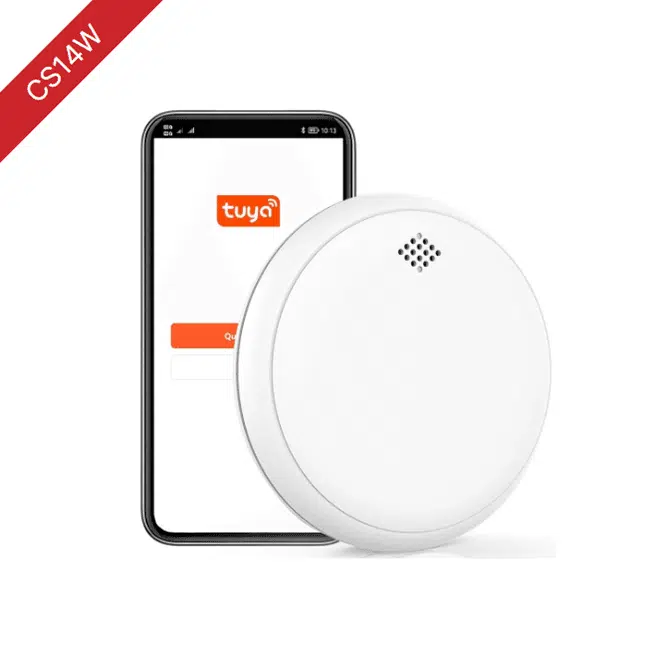
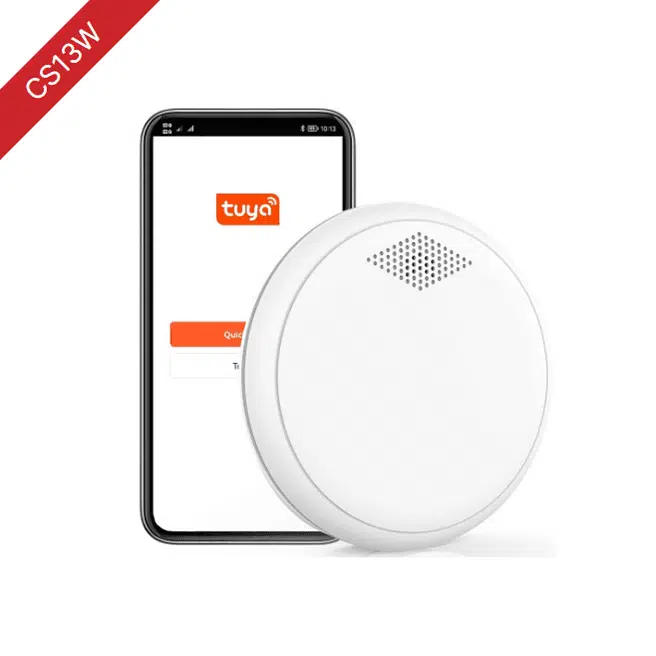
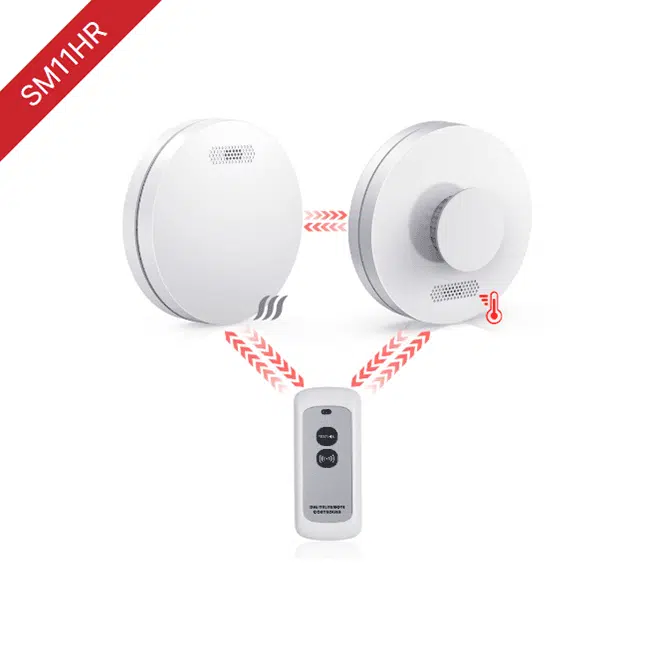
“Interconnected 10-year battery smoke alarms” refer to multiple alarm units linked via wireless or wired connections; when one unit detects smoke, all devices sound the alarm simultaneously. CFS supports interconnection via RF 433MHz or Zigbee 868MHz—with a single loop capable of supporting up to 30 units—and also supports Wi-Fi interconnection as well as remote monitoring via the Tuya platform.
This offers three tangible benefits for B2B clients:
For installers and property managers, interconnection also reduces the risk that a local smoke or CO event is missed in another room, especially in multi-bedroom, multi-floor and rental properties.
10-Year Battery Design and Low-Power Architecture for Combo Alarms
A 10-year battery combo alarm should be verified by an energy consumption model, not by nominal battery capacity alone. The power budget must cover standby current, smoke and CO sensor sampling, MCU sleep mode, RF/Zigbee/Wi-Fi transmission, buzzer output, LED indication, low-battery threshold and end-of-life warning.

Validation Item | Engineering Purpose |
Standby current | Assess Baseline Standby Battery Life |
Sensor sampling cycle | Balance Response Speed and Power Consumption |
MCU sleep/wake strategy | Control Long-Term Static Power Consumption |
RF/Zigbee/Wi-Fi current | Prevent Wireless Functionality from Draining Battery Life |
Buzzer alarm current | Ensure Alarm Functionality Persists in Low-Battery States |
Low-battery threshold | Prevent False Alarms or Silent Failures |
EOL warning | Ensure End-of-Life Notification Compliance |
Battery internal resistance | Validate Performance in Low-Temperature and Aged Conditions |
High/low temperature aging | Verify Stability in Extreme Environments |
Manufacturing Process Control for Stable Combo Alarm Mass Production
Many B2B projects involving Combo Alarms do not fail during the R&D phase, but rather due to issues with mass production consistency. We recommend that mass production controls encompass at least the following areas:
Why B2B Clients Should Prioritize Platform-Based OEM/ODM Development
CFS Manufacturing Capability | B2B Buyer Value |
20+ years in smoke, CO and gas alarm manufacturing | Mitigate trial-and-error risks for new projects |
5 million units’ annual capacity | Support peak-season orders and project delivery |
50+ product models | Facilitate rapid SKU configuration |
200+ brand partners | Demonstrate expertise in Private Label and ODM |
4 SMT lines + 4 post-soldering lines | Ensure batch consistency and long-term supply reliability |
Smoke / CO / Combo / Gas / Wi-Fi / RF platforms | Support platform-based product line development |

Case Study: Upgrading from Standard Smoke Alarms to a Combo Alarm Product Line
Project Background
A European security product brand sought to develop a product line of “Combo Smoke and Carbon Monoxide Alarms” targeting the residential and rental property markets. The client primarily used standalone smoke alarms; we propose using Combo alarms with 10-year battery life, wireless interconnectivity, and a brand-customized aesthetic.
Initial Customer Requirements
Initially, the client presented only three requirements:
However, following an engineering assessment, we discovered that the true determinants of the project’s success or failure were:
Root Cause
Customers tend to interpret the “Combo Alarm” merely as a “2-in-1 Smoke + CO” device; however, in reality, it is a platform-based product. Limiting production solely to a single, low-cost version would lead to three subsequent issues:
If the customer develops only one low-cost standalone version, the later cost is usually hidden in three places. Certification documents and user manuals may need to be rebuilt for every new version. Sales channels will have limited room to separate entry-level, project-level, and smart-home SKUs. If the market later requires RF interlink, Wi-Fi, or Tuya monitoring, the customer may need to restart housing design, PCB layout, and validation testing instead of extending from the original platform.
Three-Tier Product Architecture
We recommend a three-tiered product architecture:
From a technical design perspective, the smoke detection component utilizes a photoelectric chamber to identify changes in smoke particle density, while the CO detection component employs an electrochemical sensor to monitor carbon monoxide concentrations.
Project Results
What the client ultimately receives is not merely a standalone product, but rather an expandable “Combo Alarm” product line:
The retail channel features a basic model.
The engineering channel offers an interconnected model.
The smart home channel provides a Wi-Fi-enabled model.
Furthermore, future adaptations—such as country-specific certifications and localized packaging languages—can be seamlessly expanded upon within this unified platform.
For procurement managers, the value of this solution lies in reducing the complexity of supplier management; for product managers, it means shortening the time-to-market for new products; and for brand owners, it enables the establishment of a product matrix capable of generating sustainable sales.
Selection Recommendations for Brand Owners, Distributors and Project Buyers
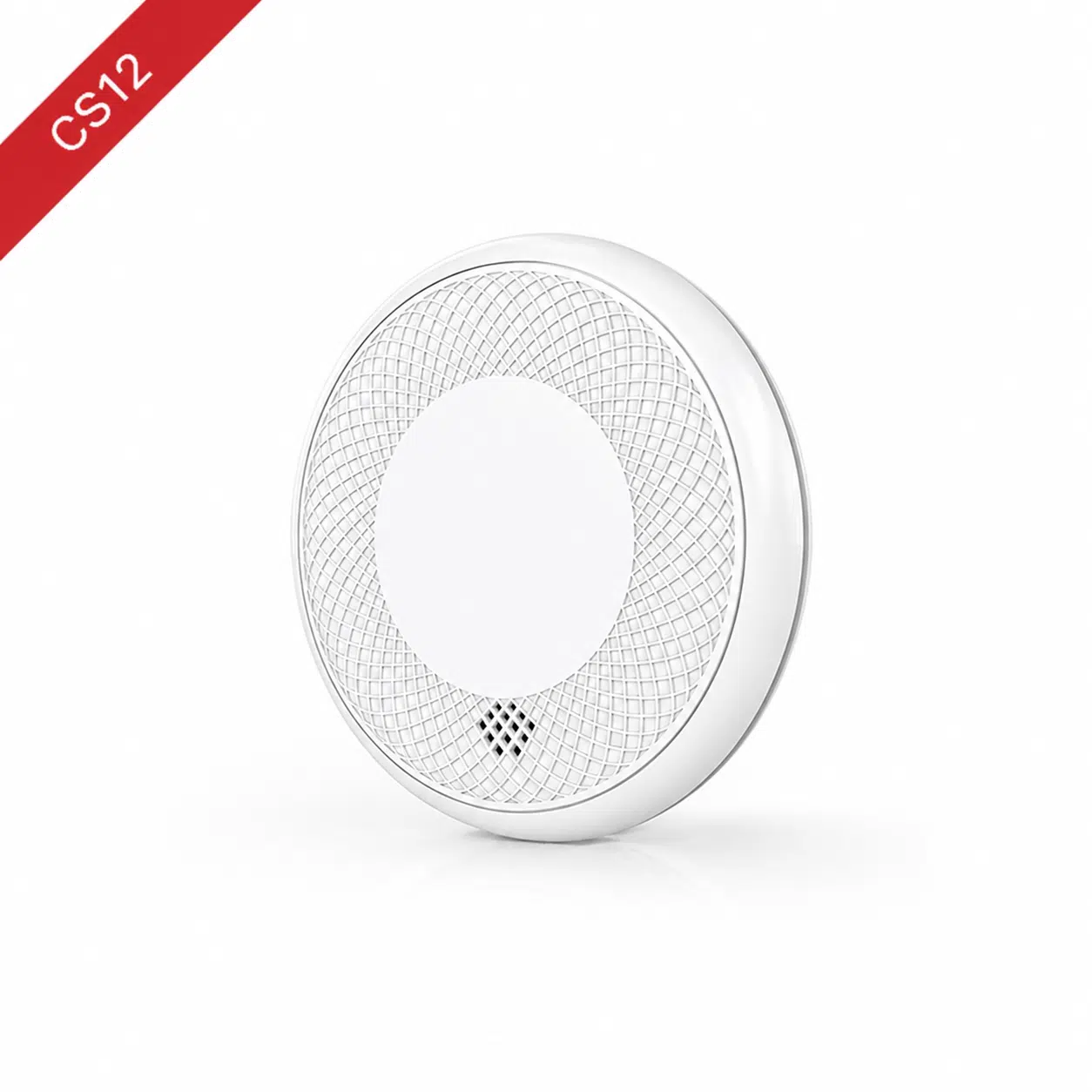
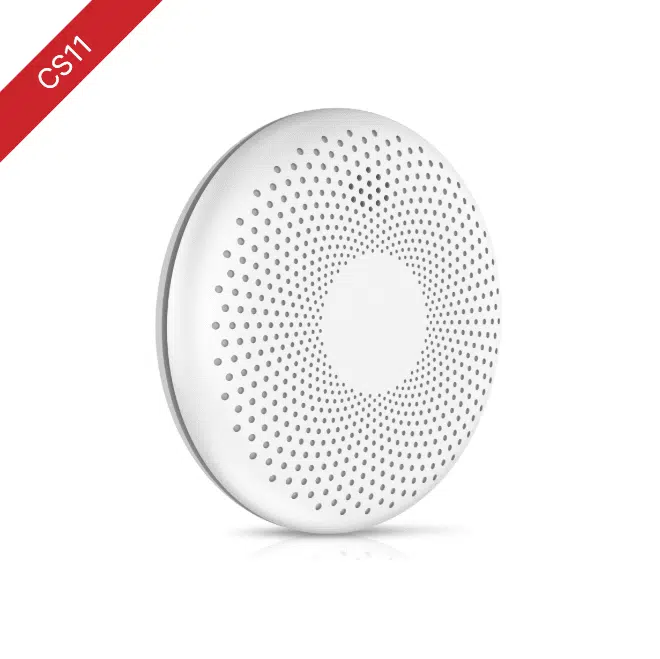
If the client is a distributor or wholesaler, we recommend prioritizing existing mature models—such as the CS11, CS11R, and CS11W series—to facilitate a rapid market entry using the client’s own logo, packaging, and user manuals.
If the client is an engineering firm or involved in property management projects, we recommend focusing on wireless-interlinked combo alarms. Wireless interlinked combo alarms usually offer stronger project value than basic standalone units. The interconnection function is more suitable for multi-room, multi-floor, and rental property applications where one local alarm may not be heard clearly in another area.

FAQ About Combo Smoke and Carbon Monoxide Alarm OEM/ODM Manufacturing
Summary
True OEM/ODM for Combo Alarms is not merely low-cost assembly, but a standards-driven engineering platform.
Competition in the market for Combo Smoke and Carbon Monoxide Alarms has evolved from the basic question of “do you have a product?” to the more critical stage of “can you consistently deliver compliant products over the long term?” For B2B clients, the optimal supplier is not simply a factory that provides a price quote; rather, it is an engineering-centric manufacturing partner capable of simultaneously mastering NFPA 72 installation logic, UL 268/UL 217 smoke detection requirements, UL 2034 CO alarm requirements, sensor principles, low-power design, interconnection protocols, and mass production consistency controls.
CFS helps brands and project buyers develop Combo Smoke and CO Alarm platforms with smoke detection, CO detection, 10-year battery design, RF/Wi-Fi interconnection, private label packaging, certification preparation and mass production consistency control.
Related Products