— OEM Guide to Compact Design, Performance Verification and Production Consistency
Quick Answer — What Is a Mini Smoke Alarm?
A mini smoke alarm is a compact warning device that integrates smoke detection, a power source, and local audible and visual alerts within a small enclosure. When sourcing such products as an OEM, in addition to comparing dimensions, one should also verify detection response, sound pressure levels, battery configuration, and the documentation required for the target market.
What Makes a Mini Smoke Alarm Different from a Standard Smoke Alarm?
Mini smoke detectors are designed to meet specific requirements for installation footprint and housing thickness. Please verify their length, width, height, and mounting base dimensions before purchase.
Buyer consideration | Mini smoke alarm | Conventional-size smoke alarm |
|---|---|---|
External dimensions | Compact footprint | Varies by model |
Installation appearance | Lower visual presence | Depends on enclosure design |
Audible warning | Must meet the applicable product requirements | Must meet the applicable product requirements |
Battery architecture | Depending on model | Depending on model |
Connectivity | Standalone or other configurations, depending on the model | Standalone, RF, Wi-Fi or hardwired options, depending on the model |
Certification | Must be verified for the exact model | Must be verified for the exact model |
OEM customization | Depends on platform and engineering scope | Depends on platform and engineering scope |
A mini alarm should not be assumed to have lower detection performance or to have performance and certification requirements that are lower simply because its housing is smaller.
How does a compact photoelectric smoke alarm work?
The working principle of a typical photoelectric mini smoke alarm is the same as that of a normal photoelectric smoke alarm.
Please read more working principle of photoelectric smoke alarm:
Compact housing alone does not determine the finished alarm’s performance.

How Small Can a Mini Smoke Alarm Be?
No single universal dimension defines a mini smoke alarm as a specific regulatory size category.
CFS’ mini-alarm range provides a practical reference:
CFS model | dimensions | Design consideration |
|---|---|---|
80 × 80 × 24.5 mm | Compact square format | |
85 × 85 × 24.5 mm | Compact square format | |
120 × 120 × 31 mm | Larger footprint within the mini product family | |
120 × 120 × 31 mm | Mini size and RF 433MHz |
The smallest possible enclosure is not the best. A compact design project normally balances enclosure dimensions, optical chamber geometry, sound selection, battery size, mounting structure, and assembly requirements.
How Does Miniaturization Affect Smoke Detection Performance?
Optical Chamber Geometry and Smoke Entry
The sensing chamber must maintain the intended optical relationship between the LED, smoke particles and receiver. Reducing the available space may require changes to chamber dimensions, component positions or the smoke-entry path.
Any change should be evaluated through appropriate testing rather than accepted solely based on a successful prototype.
Structural Change | Issues to Check |
|---|---|
Narrowed smoke inlet | Is the smoke entry restricted? Is it further compromised by dust accumulation? |
Addition of decorative grille | Does it create obstructions or zones of localized air stagnation? |
Relocation of smoke chamber | Are there differences in smoke entry based on direction? |
Reduced housing height | Do the battery, PCB, or structural ribs encroach upon the smoke entry path? |
Adjustment to base structure | Does the final installation alter the smoke entry clearance? |
Modification of housing seams | Do unintended light or smoke entry paths emerge? |
Narrow channels, internal obstructions, mounting orientation, and chamber geometry can also affect smoke alarm response speed. EN 54 tunnel test evaluates response consistency under specified conditions, and we record the sample version, airflow conditions, test medium, reference measurement values, and pass/fail results.

Sensor Baseline, Optical Reflections and Calibration
The optical labyrinth helps control unwanted external light while establishing the intended optical environment for smoke detection.
When the chamber is miniaturized, the design team should verify:
CFS usually consider the chamber, optical path, circuit, and assembly process as factors that affect smoke sensitivity during the design stage. But controlling critical parameters is more important in mass production.

What Should OEM Buyers Verify?
Before approving a compact smoke alarm platform, buyers should request or review the available evidence for:
How Should Buyers Evaluate Sound Output in a Mini Smoke Alarm?
The final output depends on several factors:
Factor | Engineering Considerations |
|---|---|
Buzzer & Drive | Resonant characteristics, drive method, and component tolerances |
Sound Port | Area, location, obstructions, and assembly effects |
Housing Structure | Acoustic cavity, mounting method, and structural vibration |
Battery | Drive capability under low voltage and load-induced voltage drop |
Environment | Changes due to temperature and aging |
Installation | Impact of the final base and mounting surface on acoustic performance |
Define the Measurement Conditions
Before development approval, the project specification should identify:
How Do You Validate Battery Life in a Compact Smoke Alarm?
CFS Batteries must be evaluated for power consumption during standby, testing, alarming, and notification functions, as well as for self-discharge and temperature effects during design stage and test the items in mass production.
Battery Configuration Options
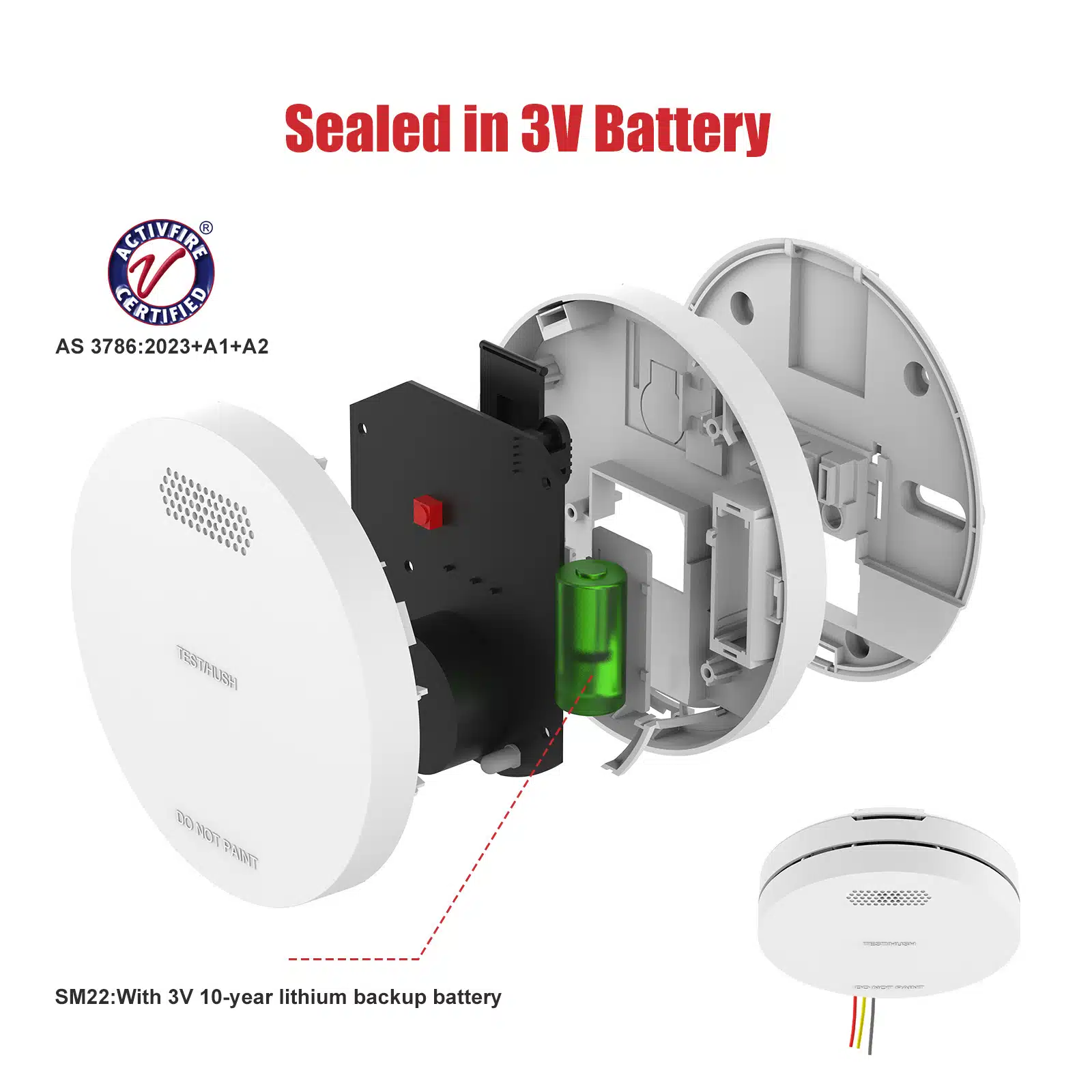
Mini smoke alarms may use different battery configurations depending on the cost and target market. CFS’s SM02 and SM04 specifications list 3 V lithium power configurations.
Sealed Long-Life Battery
A sealed battery can reduce routine battery replacement and requires consideration of the complete product’s power budget, battery characteristics, alarm-use assumptions, and required end-of-life behavior.
Replaceable Battery
A replaceable battery can be appropriate where the project prioritizes battery servicing or a particular cost structure.
Power Supply Configuration Must Match the Approved Model
Different alarm models may use different battery types and configurations. Buyers should confirm the exact battery specifications for a replacement battery.
What Should Be Included in the Power Budget?
The power budget should consider:
Battery capacity is not proof of product service life.
Can a ten-year battery life be achieved in a compact size?
The evaluation of a ten-year battery-life should consider:
The project should distinguish clearly between:
End-of-Life Notification
An end-of-life notification indicates that the product has reached the replacement point defined by the manufacturer.
OEM Buyer Checklist
Before approving the battery configuration, confirm that:
Can a Mini Smoke Alarm Support Wireless Interconnection?
Compact smoke alarms can support standalone operation, RF 433 MHz / 868 MHz interconnection or Wi-Fi connectivity. Do not infer these functions from the housing appearance. Establish whether the project needs:
How Do Mounting Design, Housing Changes and OEM Customization Affect Performance?
Mounting Base and Anti-Tamper Design
Key verification items include:
If selecting an adhesive or magnetic attachment, evaluate fixation reliability, environmental aging, installation gaps, and compliance implications separately.

Engineering Boundaries for OEM Customization
Customization requests should be classified by their potential effect on the approved product configuration.
Customization Category | Examples | Key Review Focus |
|---|---|---|
Branding and documentation | Logo, packaging, manuals and labels | Marking accuracy, model identification and document consistency |
Structure and materials | Color, coating, top cover and mounting base | Optical behavior, acoustic performance, mechanical properties and material changes |
Functionality and circuitry | Battery, sensor, PCB, firmware and communication | Detection performance, power consumption, alarm behavior and certification implications |
How Should Customization Costs Be Evaluated?
They should distinguish between using an existing platform and requiring additional engineering before quotation.
Depending on project scope, quotation items may include:

What Certifications Should OEM Buyers Verify?
Verify the Exact Certified Configuration
Before placing a production order, buyers should confirm:
How Can Miniaturization Affect Certification?
Changes to the product may affect its compliance assessment, even when the product retains the same model family name.
The review should consider the potential effects of the following changes:

Change Item | Potential Impact Areas |
|---|---|
Housing and smoke inlets | Smoke entry, response behavior and susceptibility to contamination or unwanted light |
Optical smoke chamber | Background signal, sensitivity and production consistency |
Materials and surface finishes | Optical reflection, mechanical performance and environmental durability |
Sounder and sound outlets | Sound output, power consumption and structural reliability |
Battery | Service-life assumptions, low-battery strategy and operation under alarm load |
PCB | Circuit behavior, component layout and electrical performance |
Firmware | Detection logic, alarm behavior, silence functions and fault handling |
Mounting base | Installation configuration, fixing mechanism and potential obstruction |
How to Validate a Mini Smoke Alarm Before Mass Production

Recommended Verification and Release Framework
Main Activities | Expected Deliverables | |
|---|---|---|
Specification review | Confirm target market, dimensions, power supply, service-life target and functions | Approved product specification |
Structural samples | Review installation, buttons, internal layout and workmanship | Structural review record |
Engineering samples | Evaluate smoke response, baseline, sound output and power behavior | Design verification records |
Environmental verification | Assess relevant temperature, humidity, light exposure, stress and recovery conditions | Test conditions and results |
Certification assessment | Review model, configuration and proposed changes | Applicable certification documentation |
Pilot production | Review assembly process, calibration, inspection and traceability | Pilot-run records and issue resolution |
Mass-production release | Confirm BOM, hardware and firmware revisions, test requirements and acceptance criteria | Approved production release records |
Production Test and Calibration Controls
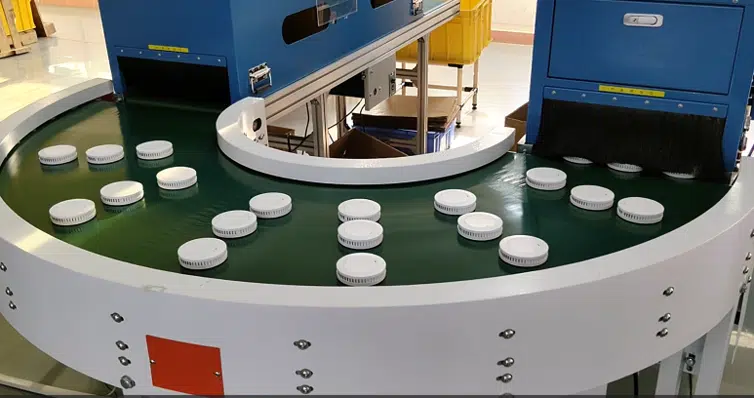
During supplier evaluation, buyers should establish which functions are verified on every finished unit and which are verified by sampling or periodic testing.
The test plan should be appropriate for the product design and the approved manufacturing control plan.
Relevant controls may include:
The exact scope of testing should be agreed according to the product requirements. A general statement that the factory performs “100% testing” is not enough unless the tested functions and acceptance criteria are clearly defined.
Why Sample Size and Version Records Matter
Verification records should identify where applicable:
Relevant changes after approval should go through documented review before release.
How Should Buyers Select a CFS Mini Smoke Alarm Platform and Compare Quotations?
CFS offers compact photoelectric smoke alarm platforms including SM02, SM03, SM04 and SM32. Certification status and approved configurations should be checked against the documentation for each model.

Initial Platform Selection
Platform | Initial Evaluation Focus |
|---|---|
SM02 | Confirm final dimensions, battery configuration and relevant technical documentation |
SM03 | Evaluate form factor, mounting base and declared service-life configuration |
SM04 | Check whether the compact structure meets the project’s dimensional constraints |
SM32 | Request the current datasheet and relevant configuration details before evaluation |
How Should Purchasing Managers Compare Quotations?
Unit prices should be compared only after the specifications, and commercial assumptions have been standardized.
Comparison Item | What to Confirm |
|---|---|
Product configuration | Exact model, dimensions, sensing technology and functions |
Battery | Type, model, replacement method and service-life assumptions |
Certification | Applicable standard, exact model coverage and document availability |
Testing | Included production checks, sampling plan and verification responsibilities |
Customization | Logo, packaging, manual, housing, color and firmware changes |
Engineering cost | Tooling, samples, testing and additional certification assessment |
Production consistency | Approved sample, BOM control and change-approval process |
Quality support | Complaint investigation, corrective action and replacement responsibilities |
Commercial terms | Order quantity, delivery schedule and packaging requirements |
Mini Smoke Alarm OEM RFQ Checklist
Before requesting a quotation, prepare the following information:
RFQ Item | Information to Provide |
|---|---|
Target market | Countries, regions and sales channels |
Application | Residential, rental housing, apartment or other defined use |
Product format | Maximum length, width and thickness, including the mounting base |
Sensing technology | Required technology or performance specification |
Certification | Applicable standard and approval requirements |
Power supply | Replaceable battery, sealed battery or other configuration |
Service-life target | Intended service period and usage assumptions |
Sound output | Required performance and measurement conditions |
Connectivity | Standalone, RF, Wi-Fi or another defined architecture |
Appearance | Color, logo, mounting and structural modification requirements |
Documentation | Datasheet, certification documents, manuals, languages and labels |
Customization | Housing, firmware, power supply or communication requirements |
Annual demand | Forecast volume and expected order schedule |
Project timeline | Sample requirements, evaluation milestones and launch target |
Quality requirements | Test records, traceability and change-control expectations |
FAQ
1. Does a ten-year battery life mean a ten-year warranty?
No. Expected battery life depends on defined operating conditions, including temperature, test frequency, and alarm activity. Product service life is the manufacturer’s declared replacement interval. Warranty coverage follows the agreed commercial terms.
2. Does pressing the test button fully verify smoke-detection performance?
Not necessarily. What the test button checks depends on the alarm’s circuit and firmware design. A button test alone does not confirm that smoke inlets are unobstructed or that the actual smoke response remains within specification.
3. What verification is needed after changing the cover or smoke inlets?
The product’s directionality and sensitivity must be evaluated internally, pass internal testing, and be recertified in the lab.
4. What certifications do your smoke alarms carry for the EU, UK, Australia and North America?
Smoke alarm products are subject to varying regulatory requirements across different countries and regions.
For residential smoke alarms, compliance standards are required:
CFS recommends that clients focus on the following:
5. Can one product platform be certified for multiple markets?
Theoretically, this is feasible, but it requires product platform planning tailored to the standards of different markets.
For instance, consider a smoke detector intended for sale in:
While the product’s exterior can remain consistent, the internal design usually requires adjustments to meet specific standards regarding:
For combined smoke and CO detectors, the differences between standards are even more pronounced; therefore, a modular platform development approach is generally recommended.
6. Do you provide CE, UKCA, RoHS and REACH documentation for customs clearance?
When exporting to the European market, customers typically require the following documents:
For large-scale OEM projects, the following may also be required:
7. Can you support certification for a customer’s private-label product?
Yes. For OEM branding projects, there are generally three certification approaches:
Option 1: Utilizing an existing certification hardware
Advantages:
Option 2: Certificate Extension
Typically requires confirming the scope of changes with the certification body.