Quick Answer — What Is a Standalone Smoke Alarm?
A standalone smoke alarm is a self-contained device without a central control panel that detects smoke and activates its own audible alarm and integrates the smoke-sensing chamber, signal-processing electronics, sounder, status indicator, test/silence control, and power supply into a single housing with a replaceable battery, a sealed long-life battery, or mains power with battery backup.
For OEM buyers, the key purchasing questions are not only “Does it detect smoke?” but also:
Standalone smoke alarms offer a lower-complexity installation than central panel fire detection systems and are commonly used in residential properties, apartments, and rental housing.
Explore Standalone Smoke Alarms →

What Is the Difference Between a Smoke Sensor, Smoke Alarm, and System Smoke Detector?
Smoke Sensor
The smoke sensor is the sensing element or sensing assembly responsible for detecting smoke particles.
In a photoelectric alarm, this normally includes:
Optical Chamber → LED → Photodiode / Receiver → Signal Circuit
The sensor alone does not provide a complete residential warning function.

Standalone Smoke Alarm
A standalone smoke alarm combines:
Smoke Sensing + Signal Processing + Audible Warning + Power Supply
into one independent product.
It can provide a local alarm without a connection to a fire alarm control panel.

System Smoke Detector
A system smoke detector typically sends signals to a fire alarm control panel rather than functioning as an independent alarm.
Depending on the system architecture, the panel may then:
How Does Standalone Smoke Alarm Work?
A photoelectric standalone smoke alarm continuously monitors changes in smoke particles; the MCU activates the integrated sounder and visual indicator to warn occupants.
Step 1 — Smoke Enters the Sensing Chamber
Air and smoke enter through the alarm housing and insect-resistant smoke-entry structure.
The chamber geometry is important because airflow, dust accumulation and insect ingress can all affect long-term sensitivity.
Step 2 — The Sensor Detects Smoke Particles
For a photoelectric alarm, an LED emits light inside the optical chamber.
Under clean-air conditions, very little light reaches the receiver.
When smoke particles enter the chamber, they scatter the light. Part of the scattered light reaches the photodiode.
Step 3 — The MCU Evaluates the Signal
The detector does not normally trigger from a single raw optical pulse.
The control circuit evaluates the sensor signal according to the product’s calibrated alarm logic.
A stable design needs to account for:
Step 4 — Alarm Threshold Is Reached
When the processed smoke signal satisfies the alarm criteria, the MCU activates the fire alarm state.
Step 5 — Audible and Visual Warning Activates
The sounder generates the required alarm output while the indicator LED shows the alarm condition.
Wireless models may additionally transmit the alarm signal to interconnected devices or a gateway.
🏭 Manufacturing Insight
The real performance of a smoke alarm depends on the entire sensing chain:
Optical Chamber → Analog Signal → MCU Algorithm → Calibration → Sounder
A high-quality optical chamber alone cannot compensate for weak calibration or unstable firmware.
What Smoke Detection Technologies Are Used?
The core of a stand-alone smoke detector is the sensor. Currently, there are two main technologies on the market:
Photoelectric Smoke Detection
In standby mode, the IC’s sixth pin outputs a pulse voltage of approximately 2-3V. This pulse is amplified by a transistor, causing the IRED to emit infrared light. This infrared light is refractured by the chamber diode, and the photosensor receives a weak infrared signal. Due to the photoelectric effect, the photodetector generates a current that is amplified by the IC’s internal amplifier and converted into a chamber output voltage.
When there is smoke, the light signal is amplified by reflection and refraction of smoke particles, increasing the conversion current and thus the chamber output voltage. When the chamber output voltage reaches the alarm threshold, the buzzer sounds.

Why is this the preferred choice for European and Australian residences?
CFS standalone smoke alarm platforms primarily use photoelectric sensing. For OEM projects, we evaluate the sensing chamber together with the analog circuit, MCU algorithm and calibration parameters rather than treating the optical sensor as an isolated component.
Ionization Sensor (We do not use this type)
The ion sensor cavity consists of three metal layers. Pressurization is applied to the first and last layers. A radiation source emits alpha particles (Helium nuclei). These alpha particles collide with air particles within the ion sensor cavity, releasing free electrons. These collided particles become positively charged due to the loss of free electrons, while the free electrons become negatively charged. Under the influence of the applied electric field, free electrons flow towards the positive terminal, and positively charged particles flow towards the negative terminal, thereby making the originally non-conductive air conductive. When smoke enters the ion sensor cavity, it obstructs the movement of charged particles. Some of the charged particles neutralize with the smoke particles, becoming non-conductive, thus lowering the voltage within the sensor. The MCU detects this change voltage lower than the threshold, an alarm is triggered. Ionization Sensor responds faster to open flames, but a significant drawback is that cooking fumes can easily trigger false alarms.

For OEM buyers, technology selection should consider the target-market requirements, intended fire scenarios, nuisance-alarm performance, material handling and certification strategy rather than response speed alone. European and Australian residential standards now favor photoelectric sensors.
Multi-Criteria or Combination Detection
Some alarm designs combine smoke sensing with:
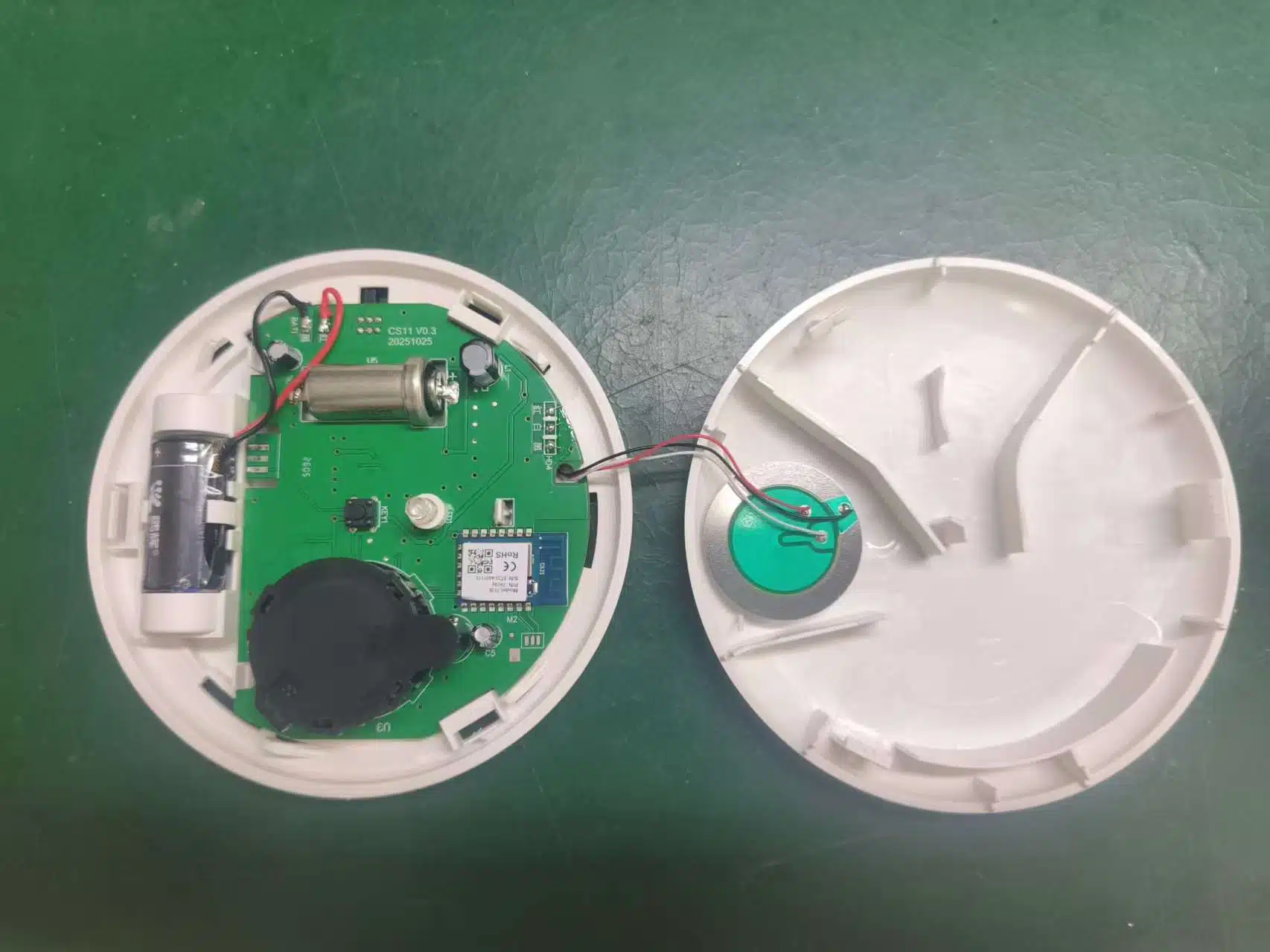
The purpose is not simply to “add more sensors” but to improve the quality of alarm decisions.
What are the power supply options for stand-alone alarm systems?
10-Year Sealed Lithium Battery (Our Flagship Solution)
A sealed long-life battery design eliminates routine user battery replacement during the intended service period.
For distributors, landlords and property managers, the main benefit is lower maintenance exposure rather than simply battery convenience.
Battery-life verification should include:
No need to worry after installation; the entire unit can be replaced after ten years. This eliminates the significant labor costs of annual battery replacements. EN 14604 Clause 4.7 and AS 3786 Clause 4.9.2 both stipulate that the battery must meet the capacity requirements for one year of static load plus weekly 10-second testing before a low-charge warning appears; after a low charge, it must maintain a 4-minute alarm or a 30-day fault warning. Our products are strictly designed according to these standards.
⚠️ Note: Do not accept a “10-year battery” claim based solely on battery capacity.
Ask the supplier for:
Battery Model + Power Budget + Standby Current + Alarm Current + Low-Battery Verification + Aging Margin
Long-life sealed-battery smoke alarms are increasingly attractive for residential, rental, and property-management projects in European and Australian markets, as they require no battery replacement.
Need a 10-Year Battery Solution?

Replaceable Battery
9V or 3V Replaceable-battery models require periodic battery replacement according to the product instructions and battery condition. The problem is that residents often forget to replace it or simply remove the battery. There is still some demand in price-sensitive markets.
However, lifecycle costs should include:
AC Power Supply (with Backup Battery)
Mains-powered standalone alarms are suitable where permanent electrical installation is available.
They reduce dependence on the primary battery but introduce additional requirements for:
AS 3786 Clause 4.10.1 requires the backup power supply to maintain 72 hours of static load, 4 minutes of alarm, and 24 hours of fault warning.

Standalone Smoke Alarm vs System Smoke Detector
Buyer Consideration | Standalone Smoke Alarm | System Smoke Detector |
|---|---|---|
Control Panel | No | Yes |
Local Audible Alarm | Integrated | System-dependent |
Installation Cost | Lower | Higher (Wiring + Testing Required) |
Identification | Local device | Zone/address possible |
Monitoring | Model-dependent | Core system capability |
Maintenance | Low | High |
Typical Architecture | Local warning | Panel-based fire detection |
Typical Standard | EN 14604 / AS 3786 / UL 217 | EN 54 series / UL 268 |
The correct choice should be based on the building fire strategy and local code requirements—not simply on which detector is cheaper.
Why B2B Buyers Choose Standalone Smoke Alarms
Lower Installation Complexity
Standalone alarms eliminate the need for a separate FACP in applications where local regulations permit independent alarms.
This can reduce:
Lower Lifecycle Maintenance
A sealed long-life battery design can reduce periodic battery-replacement work.
This matters particularly for:
Faster OEM Product Deployment
Existing certified platforms can shorten:
Easier Product-Line Expansion
A common industrial design platform can be extended into:
versions, subject to the required compliance review.
What Causes False Alarms in Standalone Smoke Alarms?
Cooking Aerosols and Steam
Incorrect installations near kitchens and bathrooms remain a major nuisance-alarm source.
Dust and Insects
Dust accumulation and insect ingress can alter optical chamber behavior.
Temperature and Humidity Changes
Environmental changes can shift optical baseline or create condensation-related interference.
Sensor Aging
LED output, photodiode response and contamination can change gradually over the alarm’s life.
Poor Installation Location
High airflow, HVAC outlets, ceiling geometry and nearby fixtures can influence smoke transport.
🔧 Engineering Recommendation
A low-false-alarm design should combine:
Optical Chamber Design + Insect Protection + Signal Filtering + Drift Compensation + Environmental Verification
What Certifications and Compliance Documents Should OEM Buyers Verify?
For OEM buyers, the first step is therefore to determine whether the product is a standalone smoke alarm or a system smoke detector. These products may look similar externally, but they follow different certification routes.
EN 14604 — European Standalone Smoke Alarm Requirements
For European standalone smoke alarm projects, buyers should verify:
Confirm that the exact model, battery configuration, PCB revision, wireless function, and product label being quoted remain within the approved product scope.

AS 3786 — Australian Standalone Smoke Alarm Requirements
For Australian standalone smoke alarm projects, verify:
For product families offering standalone, RF, Wi-Fi, or other variants, buyers should verify each configuration rather than assume that one certificate automatically covers the full series.

For long-term Australian OEM projects, include the smoke chamber, PCB, battery, firmware, and interconnection module in the engineering change-control process.
UL 217 — Certification Requirements for Standalone Smoke Alarms
UL 217 for smoke alarms provides an integral audible warning, including applicable single-station and multiple-station smoke alarm configurations.
Purchase standalone smoke alarms with UL 217, not UL 268 in North America market.
⭐ Why UL 217 Matters for Standalone Smoke Alarm Buyers
A standalone smoke alarm combines:
Smoke Detection + Signal Processing + Local Audible Warning + Power Supply
within the product architecture.
UL 217 evaluates the alarm as a complete life-safety device rather than only evaluating the smoke sensing element.
This distinction is particularly important when comparing North American residential smoke alarms with system smoke detectors.
📝 Procurement Recommendation
When reviewing a UL 217 supplier, do not ask only:
“Do you have UL?”
Ask instead:
“Is this exact model covered by UL 217, and does the production hardware match the certified construction?”
For OEM/private-label projects, changes to the housing, sensing chamber, PCB, battery, sounder, firmware, or wireless circuitry should undergo certification-impact assessment before mass production.
UL 268 — Smoke Detectors for Fire Alarm Systems
UL 268 applies to a different product category from a typical standalone residential smoke alarm.
It is primarily relevant to smoke detectors designed to operate as part of a fire alarm system, normally communicating with compatible control equipment rather than relying only on an integral standalone alarm function.
Typical applications include:
UL 268 smoke detector working:
Smoke Detector → Initiating Circuit / Addressable Loop → Fire Alarm Control Panel → Notification & Control Functions
UL 217 standalone smoke alarm works:
Smoke Detection → Internal Processing → Integrated Sounder → Occupant Warning
📝 What OEM Buyers Should Verify for UL 268 Products
If the project requires system smoke detectors, verify:
⚠️ Procurement Recommendation: Do not substitute a UL 217 standalone smoke alarm for a UL 268 system smoke detector—or vice versa—based solely on appearance or smoke-sensing technology.
They are different product categories with different intended system architectures and certification requirements.
UL 217 vs UL 268 — What Is the Difference?
Features | UL 217 | UL 268 |
|---|---|---|
Primary Product Type | Smoke Alarm | System Smoke Detector |
Typical Application | Residential / standalone warning applications | Fire alarm systems |
Integral Audible Warning | Core product function | System-dependent |
Fire Alarm Control Panel Required | Normally no | Normally yes |
Central Monitoring | Limited / architecture-dependent | System capability |
Zone / Address Identification | Normally not the primary architecture | Common in system applications |
Typical Buyer | Residential alarm brands, distributors, property suppliers | Fire alarm brands, system integrators, project contractors |
Main Procurement Focus | Complete alarm performance | Detector + system compatibility |
🎯 Buyer Takeaway
For OEM sourcing, the correct standard should follow the intended product architecture:
Standalone Smoke Alarm → UL 217
System Smoke Detector → UL 268
This distinction should be confirmed before RFQ, certification planning, tooling, PCB development, or private-label artwork begins.
RoHS & REACH — Material and Environmental Compliance
For European OEM programs, RoHS and REACH documentation should form part of the supplier technical file where applicable.
Buyers should review relevant documentation for materials and components such as:
Changes to material suppliers or critical components should trigger a compliance review rather than relying indefinitely on an older generic declaration.
Wireless Compliance — RF, Wi-Fi & Zigbee Variants
Buyers should review applicable radio and EMC requirements for RF and Wi-Fi, Zigbee, or other wireless functions separately from the base smoke alarm certification.
Typical items include:

📝 Procurement Recommendation
Do not assume:
Certified Standalone Alarm + Wireless Module = Certified Wireless Alarm
The finished wireless configuration should undergo a formal compliance-impact assessment.
For OEM buyers, select the certification route from the product architecture first:
European Standalone Alarm → EN 14604
Australian Standalone Alarm → AS 3786
North American Standalone Smoke Alarm → UL 217
North American System Smoke Detector → UL 268
Then separately review applicable RoHS, REACH, RED, FCC, EMC, and wireless requirements according to the market and product configuration.
This approach prevents one of the most common procurement errors in fire safety products: comparing two devices that both “detect smoke” but actually belong to different certification and system categories.
Not Sure Which Certification You Need?
How Should Buyers Select the Right Standalone Smoke Alarm?
Start with:
Market → Building Type → Required Standard → Power Architecture → Interconnection → Maintenance Target
Then select the model.
⚠️ Note: Do not start with the supplier’s lowest quotation.
Project Requirement | Recommended Configuration |
|---|---|
Lowest initial cost | Replaceable battery standalone alarm |
Low maintenance | Sealed long-life battery alarm |
Multi-room local interconnection | RF interlinked alarm |
Mobile notification | Wi-Fi alarm |
Smart home / property platform | Zigbee or gateway-enabled alarm |
Smoke + CO risk | Combination smoke & CO alarm |
Hardwired residential project | AC alarm with backup battery |
How to Evaluate a Standalone Smoke Alarm Manufacturer
Certification Capability
Verifying the supplier can provide market-specific documentation for the exact model.

Smoke Calibration Capability
Ask whether calibration is:
Reliability Testing
Evaluation:
Manufacturing Traceability
Verify:
BOM → PCB Revision → Firmware → Calibration → SN → Final Test

OEM / ODM Capability
CFS provides end-to-end OEM/ODM support covering product structure, PCB, firmware, alarm logic, power configuration, RF/Wi-Fi/Zigbee communication, branding, packaging and certification preparation. Projects follow a controlled process from technical assessment and engineering samples through pilot production, mass production and after-sales quality support.

Engineering Change Control
Ask how the factory controls change to the optical chamber, PCB, MCU, battery, sounder, wireless module and firmware after certification.
ECR → Engineering Review → Certification Impact Assessment → ECN → Validation → Production Release
Golden Sample & Mass Production Consistency
The approved golden sample should be linked to the controlled BOM, PCB revision, firmware version and final test specification.
Evaluating a Smoke Alarm Factory?
Why Choose CFS for Standalone Smoke Alarm OEM Projects?

Certified Product Platforms
CFS currently presents smoke alarm product families covering standalone, wireless-interlinked and Wi-Fi configurations, including long-life product options.
OEM / ODM Engineering Support
From product specification and prototyping through production and delivery, CFS provides private labeling, packaging, firmware customization and certification support.
Internal Verification Capability
Internal testing capabilities include smoke, reliability, audibility, temperature/humidity and vibration/drop testing.
Manufacturing Capacity
CFS positions itself as an OEM/ODM manufacturer serving brand owners, distributors and contractors with bulk manufacturing and project support.
CFS Dual Certification – One Product for Two Markets
For selected CFS models that hold both EN 14604 and AS 3786 certifications, distributors may be able to use a common hardware platform for European and Australian product programs, subject to market-specific labeling, documentation and regulatory requirements.
Start Your OEM Smoke Alarm Project
FAQ
Q1. What is the difference between a smoke alarm and a smoke detector?
In residential product terminology, a smoke alarm typically combines smoke sensing, signal processing, power, and an integral audible warning. A system smoke detector normally forms part of a fire alarm system and communicates with control equipment.
Q2. What is the difference between UL 217 and UL 268?
UL 217 applies to smoke alarms, including standalone and multiple-station configurations. UL 268 applies to smoke detectors intended for fire alarm systems. OEM buyers should select the standard according to the intended product architecture.
Q3. Do wireless smoke alarms need RED compliance in Europe?
Wireless products placed on the EU market may be subject to applicable RED requirements. Buyers should verify the complete wireless configuration, including the module, frequency, antenna, and relevant conformity documentation.
Q4. Do wireless smoke alarms need FCC compliance in the United States?
Applicable wireless configurations may be subject to FCC requirements. Buyers should review the radio module, FCC authorization, antenna configuration, and final host-product integration.
Q5. Are RoHS and REACH product certifications?
They are better treated as regulatory compliance requirements rather than smoke-alarm safety certifications. OEM buyers should review applicable declarations, test documentation, and material scope.
Q6. Can I put my own brand on a certified smoke alarm?
Yes, you can put the logo on the products. We also need to confirm the impact on certification before releasing labels, manuals, or packaging.
Q7. What should buyers audit before selecting a smoke alarm manufacturer?
Review certification scope, calibration, reliability testing, approved BOM control, firmware control, engineering-change management, traceability, and mass-production testing.
Q8. How should buyers compare two standalone smoke alarm suppliers?
Do not compare only FOB price. Compare:
Certification + Product Performance + Battery Validation + False-Alarm Control + Factory QC + Traceability + OEM Support + Lifecycle Cost
Q9. How can I verify a smoke alarm certificate before bulk purchasing?
Verify the certificate holder, exact model, applicable standard, and current certification scope through the issuing body or available official records. Then compare the certified configuration with the quoted product.
Q10. Can changing the battery affect smoke alarm certification?
Potentially. Battery type, electrical characteristics, and power architecture may form part of the approved product configuration. Any substitution should undergo engineering and certification-impact review.
Q11. Does adding Wi-Fi or RF require additional compliance testing?
Yes. Wireless functions introduce radio, EMC, antenna, firmware, and power-consumption considerations that may require additional regulatory assessment.
Q12. What is a golden sample in smoke alarm manufacturing?
A golden sample is an approved reference unit linked to the controlled BOM, PCB revision, firmware, and product specification. It provides a physical baseline for comparing pre-production and mass-production units.
Q13. What should be included in the OEM smoke alarm RFQ?
Include:
Target Market + Required Standard + Product Type + Battery Architecture + Interconnection + Wireless Function + Branding + Packaging + Annual Volume
allows the manufacturer to quote against the correct technical and compliance configuration.


