—–Voice Alerts, Fire vs CO Identification, Room Location, Multi-Language Firmware & OEM Engineering Guide
Quick Answer — What Is a Voice Smoke and CO Alarm?
A voice smoke and CO alarm combines audible alarm patterns with spoken messages to identify the detected hazard, such as smoke/fire or carbon monoxide. Depending on the product architecture, an interconnected voice alarm may also announce the room or location where the event originated.
For OEM projects, voice is not simply a speaker function. The specification should define the alarm pattern, voice message, event priority, language version, room-location logic, interconnection behavior, acoustic output, firmware version and certification scope.
Instead of relying only on a buzzer or horn, a voice-enabled alarm may provide different spoken messages for:
Fire / Smoke Alarm → Carbon Monoxide Alarm → Low Battery → Fault → End of Life → Test / Hush Status
More advanced interconnected platforms may also identify a programmed room or alarm location, such as:
“Smoke detected in the kitchen.”
“Carbon monoxide detected in the basement.”
For an OEM buyer, however, adding voice is not simply an audio-feature decision. The complete specification needs to define the alarm pattern, voice message, event priority, language version, speaker output, room-location architecture, interconnection behavior, firmware version and applicable certification requirements.
CFS currently supports sound/voice audio modes and firmware customization on selected alarm platforms, while its Combo Alarm portfolio includes voice notification as an ODM option subject to market and certification requirements.

Why Are Voice Smoke and CO Alarms Different from Standard Alarms?
A standard alarm mainly communicates through a high-output audible warning pattern.
A voice alarm adds another information layer.
Function | Standard Buzzer Alarm | Voice-Enabled Alarm |
|---|---|---|
Audible warning | Yes | Yes |
Fire alarm pattern | Yes | Yes |
CO alarm pattern | CO models | Yes |
Spoken hazard identification | No | Optional/Yes |
“Fire” voice prompt | No | Yes, if configured |
“Carbon Monoxide” prompt | No | Yes, if configured |
Room/location announcement | No | Platform-dependent |
Multiple languages | No | Platform-dependent |
Firmware/audio management | Relatively simple | More complex |
Speaker/audio validation | Basic audible output | Buzzer + voice path may require separate validation |
The important engineering distinction is:
Buzzer Pattern ≠ Voice Message ≠ Location Message
They are three different information channels and should be separately specified and validated.
A voice message should support the safety function of the alarm, not make the underlying hazard detection or require audible alarm architecture ambiguous.

Buzzer vs Voice: What Is the Difference?
A buzzer, horn or sounder generates the primary audible warning.
A voice circuit reproduces intelligible prerecorded or synthesized speech.
They serve related but different functions.
For example, the product could produce:
Audible Pattern → Voice Message → Audible Pattern
rather than replacing the alarm pattern entirely with speech.
CFS already has a dedicated article explaining how fire, CO, low-battery and end-of-life audible indications should be distinguished. Its current engineering guidance identifies fire and CO as different danger-alarm conditions and separates them from maintenance indications such as low battery and end-of-life.
Why shouldn’t OEM buyers specify only “voice alarm”?
Because this leaves several questions unanswered:
These parameters should be frozen before certification and mass production.

How Does a Voice Smoke and CO Alarm Distinguish Fire from Carbon Monoxide?
This is particularly important for a smoke + CO combination alarm.
The user should not have to determine the hazard by guessing what an LED means.
A well-defined interface may combine:
Event | Audible Indication | Voice | LED/UI |
|---|---|---|---|
Smoke/Fire | Fire alarm pattern | “Fire” / equivalent | Red |
CO | CO alarm pattern | “Carbon Monoxide” / equivalent | Red or specified indication |
Low Battery | Maintenance chirp | “Low Battery” | Status indication |
End of Life | EOL pattern | “Replace Alarm” | Status indication |
Fault | Fault indication | “Fault” if supported | Fault indication |
Test | Test sequence | Test voice | Test indication |
The exact cadence and required indications must follow the applicable product standard and the certified product configuration rather than a generic table copied between markets.
This distinction is commercially important because CFS’s current sound-logic content already separates fire, CO, low-battery and EOL conditions rather than treating every audible event as the same “beep.”
The voice message should follow the confirmed alarm state; it should not be used as the mechanism that determines the hazard type.
From an engineering perspective, the product can be divided into six functional stages:
Smoke / CO Sensor → Signal Processing → Hazard Classification → Alarm Logic → Buzzer + Voice Logic → User Notification
For a combination product, the smoke and CO channels are normally independent at the sensing level.
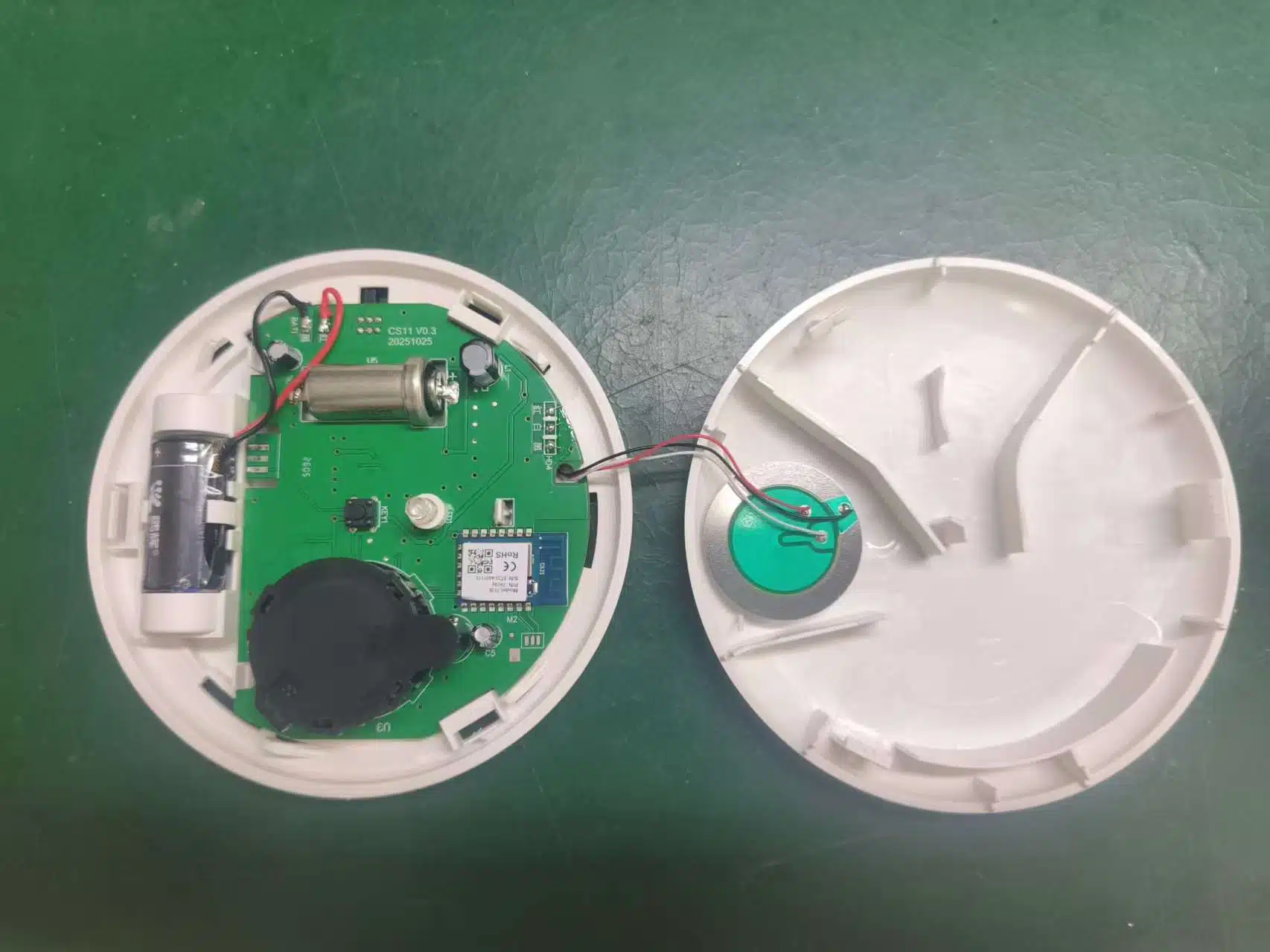
The smoke channel may use a photoelectric chamber, while the CO channel uses an electrochemical sensor. CFS’s current CS11/CS12 combination products use photoelectric smoke sensing together with electrochemical CO sensing.
The MCU or control circuit evaluates the input and determines the event state.
For example:
Smoke threshold reached
→ Fire event confirmed
→ Fire audible pattern activated
→ Red indicator activated
→ Fire voice message played
while:
CO alarm condition reached
→ CO event confirmed
→ CO audible pattern activated
→ Red indicator activated
→ CO voice message played
The critical point for a product manager is that the voice file itself does not determine whether an event is a fire or CO event.
That decision must come from the product’s detection and alarm logic.

How Does Room Location Work in a Voice Smoke Alarm?
Room Assignment During Installation
Room-location announcement is a more advanced function than simple hazard identification.
Consider an interconnected system containing alarms in:
Bedroom → Hallway → Living Room → Kitchen → Basement
If a basement alarm detects smoke, interconnected alarms elsewhere may sound.
A basic interconnected product tells occupants:
There is an alarm somewhere in the network.
A location-enabled voice system may additionally communicate:
Smoke detected — Basement.
This requires more than adding another audio file.
The system needs some way to associate an alarm with a location.
Device ID and Location Mapping
Several architectures are possible.
One approach is installation-time room assignment. Each alarm is installed in the Bedroom, Kitchen, Hallway, Basement, or Living Room.
Another approach uses an APP or commissioning interface to associate each device ID with a room.
How the Originating Alarm Is Identified
The alarm network then needs to communicate enough event information for other units or the associated controller/application to identify:
Which device initiated the alarm + What hazard occurred + Which location is assigned to that device.
This creates an important engineering distinction:
Interconnection ≠ Location Identification
A product can make every alarm sound simultaneously without knowing which room initiated the event.
CFS’s current RF products already demonstrate the first architecture: interconnected alarms can propagate an alarm across paired units. For example, CFS’s RF guide describes synchronous cross-unit alarming when one paired device detects a hazard.
Room identification is an additional architecture that must be deliberately designed and validated.

Local Alarm vs Remote Alarm: Should the Voice Be Different?
Suppose Alarm A detects smoke and Alarm B receives the RF interconnection message.
There are now two different states:
Alarm A = Originating / Local Alarm
Alarm B = Remote / Interconnected Alarm
From an engineering perspective, these states should be explicitly defined.
Condition | Originating Alarm | Remote Alarm |
|---|---|---|
Smoke detected locally | Local fire alarm | Receives interlink event |
Voice message | Fire + optional location | Fire / remote location if supported |
LED behavior | Identify initiating unit | Remote alarm indication |
Silence behavior | Defined by firmware | Defined by network logic |
RF communication lost | Local alarm remains functional | Remote propagation unavailable |
Location identification | Local assignment known | Requires transmitted location/device data |
The specification should answer:
CFS already positions interconnection validation and RF stability testing as part of its smart/interconnected alarm manufacturing process.
For a voice-interconnected platform, that validation needs to extend to event type and voice-message propagation, not only whether all units make a sound.

Planning an Interconnected Voice Alarm?
Need fire/CO identification, room-location announcements or different local and remote alarm logic? Send CFS your interconnection requirements for an initial engineering review.
What Happens If Smoke and CO Are Detected at the Same Time?
A combo alarm may theoretically encounter:
The firmware therefore needs an event-priority table.
Event | Priority | Audible Pattern | Voice | LED | RF Message | Silence |
|---|---|---|---|---|---|---|
Smoke alarm | Define | Define | Define | Define | Define | Define |
CO alarm | Define | Define | Define | Define | Define | Define |
Low battery | Lower than life-safety event | Define | Optional | Define | Platform-dependent | Define |
Fault | Define | Define | Optional | Define | Platform-dependent | Define |
Remote alarm | Define | Define | Define | Define | Received | Define |
For example:
Life-Safety Alarm > Maintenance Warning
But the precise priority between simultaneous hazard conditions and how each condition is communicated should be defined against the applicable product architecture and certification requirements.
The OEM specification should therefore include:
Event → Priority → Buzzer Pattern → Voice Message → LED Pattern → Interconnection Message → Silence Behavior
This becomes part of firmware configuration control.
How Does Language Customization Work?
A voice alarm for the US market may require English.
A Canadian project may introduce English/French requirements depending on product and market requirements.
European projects may require different language SKUs for Germany, France, Spain, Italy or other target markets.
A Middle East project may request Arabic plus English.
CFS already states that multilingual voice firmware banks can be configured on some customized platforms, including examples such as English, German, French, Spanish, Mandarin and Arabic.
But buyers should not interpret this as:
One hardware platform + any audio file = immediately market-ready.
The selected language configuration must still be reviewed against the product’s certification, labeling, user instructions, memory capacity and production configuration.
Single-Language or Multi-Language Voice Alarm?
There are two common product strategies.
Single-Language SKU
Each SKU contains one target language.
Examples:
This can simplify user operation and production configuration, although it creates more SKUs.
Multi-Language Platform
The same hardware may store several language banks.
The selected language may be configured during manufacturing, commissioning or user setup, depending on the architecture.
This reduces hardware fragmentation but increases firmware/configuration-management requirements.
For procurement, the question should therefore not simply be:
“Can you add German?”
It should be:
“How is the German audio version controlled from approved firmware through programming, EOL verification, labeling, packaging and shipment?”
That is the difference between prototype customization and controlled mass production.
Why Language Version Control Matters in Mass Production
A wrong-language shipment is not necessarily a hardware failure. The PCB may pass every electrical test while the finished SKU is still incorrect.
For multilingual programs, the language version should therefore be linked to the approved firmware, SKU, product label, user manual, packaging and production traceability record.

Need a Custom Language or Voice Configuration?
Send us your target market, required language, voice messages and product architecture. CFS can evaluate firmware, speaker output, acoustic performance and production configuration before sampling.
Voice File Quality Is Also an Engineering Requirement
This is frequently underestimated.
A clean WAV/PCM file on a computer does not guarantee intelligible speech from a small alarm enclosure.
Final output depends on:
Audio File → Codec/DAC → Amplifier → Speaker → Acoustic Chamber → Housing Openings → Installation Environment
The housing itself changes acoustic performance.
Therefore:
Good Audio File ≠ Good Finished-Product Voice Performance
Engineering validation should be performed on the assembled product rather than approving only the original audio file.
How Do the Speaker and Alarm Housing Affect Voice Quality?
In a compact smoke or CO alarm, the speaker does not operate independently of the housing. Speaker position, sound openings, internal cavity volume, PCB placement and mechanical sealing can change the finished acoustic response.
A speaker that performs well during bench testing may produce different results after installation inside the final enclosure.

What Should Be Verified for Voice Intelligibility?
For an OEM program, CFS should recommend at least:
Speaker output consistency, speech intelligibility, clipping/distortion, message completeness, pronunciation accuracy, language correctness, buzzer-to-voice transition, repeated-message timing, low-battery operation, temperature performance, and unit-to-unit variation.
One useful production rule is:
Voice Content + Voice Sequence + Acoustic Output should all be controlled.
A unit that plays the correct audio file but produces distorted or incomplete speech should not be considered functionally equivalent to the approved golden sample.
Voice verification should consider not only SPL, but also distortion, frequency response, enclosure resonance and message intelligibility across the declared operating-voltage range.
Is 85 dB at 3 m Required for a Voice Smoke Alarm?
This needs careful wording.
Do not write:
“Voice alarms must be 85 dB at 3 m.”
as a universal statement.
Instead distinguish:
Alarm signal sound-pressure requirement
from
Voice-message intelligibility / voice output
and verify both against the applicable product standard and certified configuration.
CFS’s current CS14 and CS13 product pages, for example, specify sound output above 85 dB(A) at 3 m for those particular products.
That product specification should not automatically be converted into a universal voice-message requirement.
This sentence is worth highlighting:
Alarm Sound Pressure ≠ Voice Intelligibility
A loud voice can still be difficult to understand if distortion, enclosure resonance, pronunciation or signal sequencing is poor.

How Should Sound Pressure Be Verified?
Don’t validate only one engineering sample.
For production, establish:
Test Distance + Microphone Position + Background Noise + Alarm State + Supply Voltage + Test Fixture + Acceptance Limit
Then control these parameters consistently.
A practical validation plan can include:
Golden Sample → EVT/DVT Acoustic Verification → Pilot Run → Production EOL Audio Check → Periodic Audit
For long-life battery products, you should evaluate acoustic output across the intended operating range, especially at low voltage, not only with a fresh laboratory power source.
Does Voice Increase Battery Consumption?
Yes, it adds an additional load, but the purchasing question should be more precise:
How much energy does the complete voice-event profile consume over the declared product life?
A voice system adds some combination of:
Audio memory + MCU processing + amplifier + speaker operation
For a 10-year sealed-battery alarm, battery validation therefore needs to include realistic voice events in addition to:
standby current, sensor sampling, LED operation, user tests, alarms, low-battery warning, self-discharge, temperature derating, component aging and end-of-life reserve.
This gives us another useful engineering principle:
10-Year Battery Capacity ≠ 10-Year Voice Alarm Service Life
The entire usage profile has to be budgeted.
What Should Be Included in a Voice Alarm Power Budget?
Load | Why It Matters |
|---|---|
MCU standby | Continuous base consumption |
Smoke sensing | Sampling/detection load |
CO sensor | Continuous/sampling load |
RF standby | Interconnection products |
Wi-Fi | Smart models only |
LED | Status indication |
Audio amplifier | Voice playback |
Speaker | Voice/alarm event |
User test | Lifetime usage assumption |
Alarm events | High-current condition |
Low-battery warning | End-of-life reserve |
Battery self-discharge | Long-life design |
Temperature derating | Capacity variation |
Aging | Lifetime margin |
Engineering reserve | Production variation |
How Does Voice Work in an Interconnected Alarm Network?
There are at least three levels of implementation.
Level 1 — Sound Interconnection
One alarm detects a hazard and all interconnected alarms sound.
Level 2 — Hazard-Type Interconnection
The network communicates whether the event is smoke/fire or CO, allowing receiving units to provide the corresponding warning.
Level 3 — Hazard + Location Interconnection
The network communicates enough information to determine:
Event Type + Originating Device + Assigned Location
This allows a receiving alarm to announce information such as the type and source location.
The buyer should therefore ask:
What information is actually transmitted across the interconnection network?
Not simply:
“Does it interconnect?”
CFS already offers RF-interconnected platforms and describes interconnection validation as part of its manufacturing/testing capability.
What Happens if Wi-Fi or the Internet Goes Down?
For products combining Wi-Fi with RF interconnection, these are different communication layers.
A properly defined product architecture may use local RF for alarm-to-alarm interconnection while Wi-Fi is used for APP/cloud communication.
Therefore:
Wi-Fi Connectivity ≠ Local Alarm Interconnection
The RF architecture needs to be evaluated independently.
This is particularly important for buyers who want voice location information, because they need to establish whether room/location data is stored locally, in the alarm network, in an APP/cloud account, or in another controller.
Voice Smoke Alarm vs Voice Smoke + CO Combo Alarm
Specification | Voice Smoke Alarm | Voice Smoke + CO Alarm |
|---|---|---|
Smoke detection | Yes | Yes |
CO detection | No | Yes |
Fire voice | Optional | Optional |
CO voice | No | Optional |
Hazard differentiation | Simpler | More important |
Event-priority logic | Lower complexity | Higher complexity |
Sensor architecture | Smoke | Smoke + electrochemical CO |
Firmware logic | Moderate | More complex |
Audio message set | Smaller | Larger |
Battery budget | Voice load | Dual sensing + voice load |
Certification planning | Smoke requirements | Smoke + CO combination requirements |
This is also the natural place to link to CFS’s Combo Smoke and Carbon Monoxide Alarm portfolio. CFS currently offers multiple 10-year smoke + CO combo models, and its collection page specifically identifies voice notification as an available ODM option for selected projects.
What Standards Should OEM Buyers Consider?
Avoid creating a simplistic “one voice standard” table.
The applicable requirements depend on:
Target Country + Product Type + Smoke Function + CO Function + Power Architecture + Interconnection + Voice Implementation
The correct procurement workflow is:
Define Market → Define Product Architecture → Identify Applicable Standards → Freeze Voice/Alarm Logic → Confirm Certification Scope → Freeze Production Configuration
Do not take an existing non-voice certificate and assume a firmware, speaker, amplifier or voice-logic change is automatically covered.
Does Adding Voice Require Re-Certification?
Potentially.
The answer depends on what is changed and the certification scheme.
A voice feature can affect:
PCB/BOM → Speaker → Amplifier → Firmware → Alarm Sequence → Current Consumption → Battery Life → Housing Acoustic Path → User Instructions
For an OEM project, any such modification should go through formal engineering change review before mass production.
The manufacturer should determine whether the change is:
Within existing approved configuration
or
Requires supplementary evaluation/testing/certification update.
This is much more credible than promising buyers that “adding voice does not affect certification.”
Please see the work flow:
Engineering Change → Certification Impact Assessment → Required Verification → Approval → Production Release
What Should an OEM Voice Alarm Specification Include?
Specification Item | Buyer Should Define |
|---|---|
Target market | US / Canada / EU / UK / AU etc. |
Product type | Smoke / CO / Smoke+CO |
Power | Battery / sealed battery / AC+backup |
Interconnection | Standalone / RF / hardwire / Wi-Fi+RF |
Fire pattern | Applicable market requirement |
CO pattern | Applicable market requirement |
Fire voice | Required wording |
CO voice | Required wording |
Low-battery voice | Required / not required |
EOL voice | Required / not required |
Fault voice | Required / not required |
Room location | Required / not required |
Number of locations | Defined list |
Language | English / French / German etc. |
Number of languages | Single / multiple |
Voice selection | Factory / installer / user |
Sound output | Defined acceptance requirement |
Voice intelligibility | Validation method |
Event priority | Defined matrix |
Local/remote alarm | Defined |
Silence logic | Defined |
Firmware version | Controlled |
Certification | Exact target requirement |
Annual volume | Forecast |
Private label | Logo / packaging / manual |
Developing a Voice Smoke or CO Alarm?
Send us your target market, required languages, alarm type and interconnection architecture. CFS can review the hardware, firmware, voice logic and certification path before quotation.
How Should a Voice Alarm Be Validated Before Mass Production?
Don’t stop at:
Prototype speaks correctly → PASS
Instead use:
Engineering Sample → Approved Voice File → Golden Sample → Pilot Production → EOL Verification → Mass Production
Validation should cover at least:
The key message:
Prototype Voice Pass ≠ Mass-Production Voice Consistency
How Should Voice Firmware Be Controlled in Production?
For multilingual OEM projects, firmware control becomes a supply-chain issue.
Imagine:
All three may look identical externally.
A production operator loading the wrong firmware could create a batch-level market failure even if every PCB is electrically functional.
Therefore, production records should connect:
SKU → Hardware Revision → Firmware Version → Voice Bank → Language → Label → Manual → Packaging → Serial/Lot Number
This is where traceability becomes commercially important.
CFS currently describes traceable barcode systems, PPAP/process control, OQA and 8D within its OEM manufacturing framework.
For voice products, the same philosophy should extend to voice/firmware configuration traceability.
What Should Be Tested at 100% EOL?
100% Voice Alarm EOL Test


Not every certification-level acoustic or environmental test needs to be repeated on every production unit, but every unit should have a defined production functional test appropriate to the approved manufacturing control plan.
Common OEM Procurement Mistakes
Common Mistake | Why It Creates Risk |
|---|---|
“Just add a speaker” | Voice requires hardware + firmware + acoustic validation |
Only checking dB | Loudness does not guarantee intelligibility |
Not defining fire vs CO voice | Creates user-interface ambiguity |
No event-priority matrix | Simultaneous events may behave incorrectly |
Assuming interlink means location | Basic RF interlink may not transmit room information |
Changing language after certification | May affect approved configuration |
No firmware traceability | Wrong-language production becomes possible |
Testing only one prototype | Does not prove production consistency |
Ignoring battery impact | Voice amplifier adds energy consumption |
Assuming one language SKU fits every market | Market/certification/label requirements differ |
How CFS Structures a Voice Smoke and CO Alarm OEM/ODM Project
A voice-alarm OEM/ODM project should begin with the system specification rather than the speaker or audio file:
Target Market → Alarm Type → Detection Architecture → Power Architecture → Interconnection → Alarm Patterns → Voice Messages → Languages → Location Logic → Event Priority → Certification Scope
Engineering can then evaluate:
Sensor Platform → MCU Resources → Audio Memory → Amplifier → Speaker → Acoustic Housing → Firmware → Battery Budget
After the architecture is frozen:
Engineering Sample → Acoustic/Functional Validation → Certification Configuration → Golden Sample → Pilot Production → EOL Test → Traceability → Mass Production
CFS’s current site supports this positioning: it lists OEM/ODM manufacturing, custom design, certification assistance and firmware customization, while its smart-alarm manufacturing pages describe functional testing, interconnection validation and traceability-related process controls.
Need a Custom Voice Smoke or CO Alarm?
Send your target country, required language, product type and annual volume to CFS for an initial engineering review.
FAQ — Voice Smoke and CO Alarms
1. Do voice smoke alarms still beep?
Yes. Voice is generally an additional information channel rather than a substitute for every required audible warning function. The exact alarm and voice sequence depends on the product design and applicable requirements.
2. What is the difference between a voice smoke alarm and a regular smoke alarm?
A regular alarm primarily uses an audible alarm pattern. A voice-enabled product can additionally communicate hazard type, maintenance status or, on supported interconnected platforms, location information.
3. Can a smoke and CO alarm use different voice messages?
Yes. A combination platform can assign different messages to smoke/fire, CO and other defined states when supported by the firmware and product architecture.
4. Can a voice smoke alarm tell which room detected smoke?
Only when the system supports device/location assignment and can identify the originating alarm. Basic alarm interconnection does not automatically provide room identification.
5. Can interconnected smoke alarms announce the originating room?
Yes on platforms specifically designed to transmit originating-device or location information. A generic RF alarm message may only trigger remote alarms without identifying the source location.
6. Can voice smoke alarms support multiple languages?
Yes, depending on audio memory, MCU resources, firmware architecture and approved product configuration. For OEM production, each language version should be controlled through firmware, SKU, labeling, instructions and traceability.
7. Is 85 dB at 3 m required for the voice message?
Do not treat alarm-signal sound pressure and voice intelligibility as the same requirement. The applicable product standard and certified configuration should be checked for the specific market.
8. How is voice intelligibility tested?
Testing may consider sound pressure, distortion, message completeness, pronunciation, speaker performance, enclosure acoustics, supply voltage and repeatability under defined test conditions.
9. Does adding voice reduce battery life?
Voice playback adds load from the processor, amplifier and speaker. For a long-life battery product, this should be included in the complete lifetime power budget.
10. What happens if smoke and CO are detected at the same time?
The product needs a defined event-priority and notification strategy. The exact buzzer, voice, LED, interconnection and silence behavior should be specified and validated for the intended product configuration.
11. Will interconnected voice alarms still work if Wi-Fi is unavailable?
It depends on the architecture. Products using local RF for alarm interconnection may operate independently of the Wi-Fi/cloud layer, but this must be confirmed for the specific platform.
12. Can voice be added to an existing certified smoke alarm?
Possibly, but changes to the speaker, amplifier, PCB, firmware, current consumption, alarm sequence or housing may affect the approved configuration. A certification impact assessment should be completed before release.
13. How do OEM manufacturers prevent the wrong language from being programmed?
A controlled production process should link the SKU to the approved hardware revision, firmware version, voice bank, language, label, manual, packaging and production traceability record.
14. What information should I send for a voice smoke or CO alarm quotation?
Provide the target country, product type, required standards, power architecture, interconnection method, required languages, room-location requirement, voice messages, annual volume and private-label requirements.
Conclusion
For procurement teams, the right question is not:
“Does this smoke alarm have voice?”
A better RFQ question is:
“How does the product distinguish fire, CO, maintenance and interconnected events; how are voice language and room location controlled; and how do you verify acoustic performance, firmware configuration and production consistency?”
A voice smoke and CO alarm should be treated as a complete system:
Detection + Alarm Pattern + Voice + Location + Interconnection + Firmware + Power + Certification + Production Control
That is what determines whether a voice feature remains reliable after the product moves from an engineering sample into tens of thousands of production units.
Ready to Develop Your Voice Smoke or CO Alarm?
Whether you need a standalone voice alarm, smoke + CO combination alarm, RF-interconnected platform, room-location voice alerts or a multi-language OEM version, start with the system specification.
Send CFS your target market, certification requirements, voice languages, interconnection architecture and estimated annual volume for an initial engineering assessment.