Quick Answer
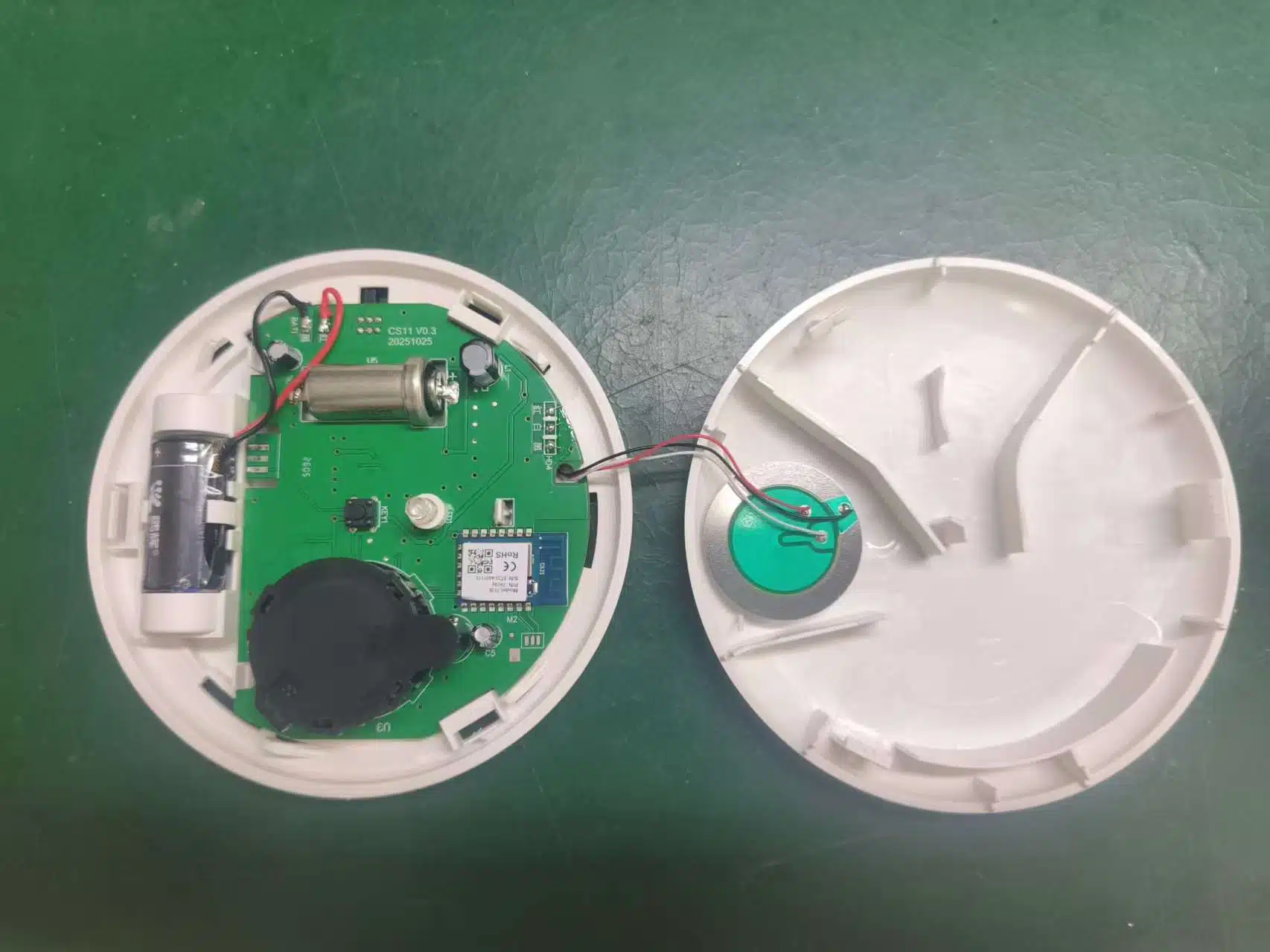
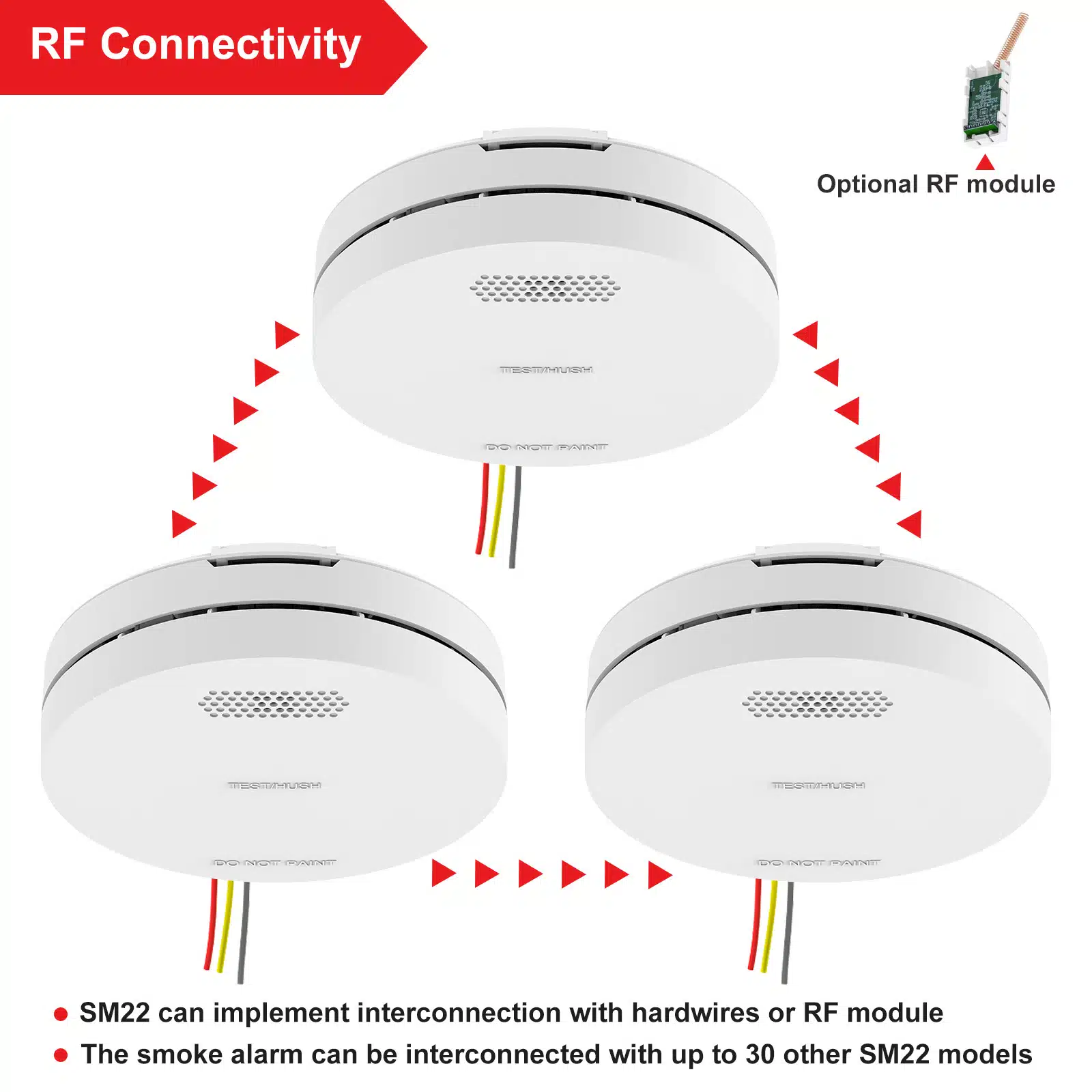
A Wi-Fi + RF 433MHz hybrid interlinked smoke/CO alarm integrates an offline 433MHz RF radio network and 2.4GHz Wi-Fi, enabling full-building synchronous local alarm linkage, cloud connectivity, mobile APP remote alerts, and property management platform data uploads.
The two communication channels operate fully separately without mutual reliance. If Wi-Fi disconnects, the RF remains 100% active to ensure simultaneous fire/CO alerts across all paired units. It solves the core flaws of standalone Wi-Fi or single RF alarms and is suitable for apartments, rental housing, hotels, and managed residential property OEM mass projects.

Planning a Hybrid Smoke Alarm Project?
Discover how our OEM engineering team can help you develop EN 14604-compliant Wi-Fi + RF smoke alarm solutions for residential and property management projects.
Why Combine Wi-Fi and RF 433MHz in One Smoke Alarm?
Limitations of Standalone RF 433MHz Only Systems
Limitations of Standalone Wi-Fi Only Smoke Alarms
Core Advantages of Hybrid Wi-Fi + RF Dual Architecture

How Does Wi-Fi & RF 433MHz Hybrid Interlink Work?
Step 1: Local Smoke / CO Hazard Detection
Step 2 RF 433MHz Local Synchronous Linkage
Step 3 Wi-Fi Cloud Data Upload
Step 4 Multi-Target Remote Push Notification
Offline Protection Backup Mechanism (Core Safety Design)
Internet Disconnect / Router Power Failure
→ Wi-Fi module automatically enters low-power dormant state
→ RF radio channel keeps full-time signal listening & broadcast function
→ All interlink, self-test, fault indication logic remains completely functional offline

System Architecture of Wi-Fi + RF Hybrid Smoke Alarm
Local RF Mesh Network Layer
All Wi-Fi + RF alarms in the same building form an independent offline RF mesh group, supporting 30–50 paired devices with multi-hop signal relay across walls/floors, no central hub needed.
Home Wi-Fi Router Layer
Acts as a bridge between the local device and the remote cloud; only responsible for internet data transmission; does not control RF link signals. A router outage has no impact on local alarm synchronization.
Central Cloud Server Layer
Dedicated cloud storage, alert distribution, batch device management, historical data archiving, OTA firmware update service for OEM private-label brands. Supports single-family user accounts and bulk property enterprise accounts separately.
End-User Mobile Application Layer
White-label customizable Android & iOS APP: real-time alerts, device status query, remote self-test, alarm history review, home smart scene linkage setup.
Property Management Backend Platform Layer
Web-based dashboard for real estate operators: multi-building batch monitoring, fault statistics, maintenance task assignment, monthly safety report export, tenant alert forwarding.
Why Wi-Fi + RF Is Becoming the Future of Residential Fire Safety
Dual Wi-Fi & 433MHz RF interlinked smoke/CO alarms are no longer a niche smart home product — they have become the dominant long-term solution for global residential fire safety, driven by updated fire codes, property management demands, smart digital transformation, insurance risk policies, and mass apartment/housing project requirements. Single RF-only or standalone Wi-Fi devices cannot balance mandatory offline life safety and modern digital management needs, making hybrid dual wireless architecture the industry’s mainstream future standard. Below breaks down the six core market driving forces:
Fully Compliant with Updated EN14604 & Global Fire Safety Regulations
EN 14604 (EU residential smoke alarm standard), AS 3786 (Australia), and UK housing laws all set hard rules for interconnection functionality: all linked detectors must trigger synchronously, without reliance on the internet or a router.
For OEM brands targeting Europe, the UK, and Australia, hybrid dual-radio products eliminate certification and project tender-rejection risks, making them the only fully code-compliant smart fire safety option.
Unmatched Total Cost Advantage for Property Management Groups
Property developers, landlords, and housing associations represent the largest bulk buyers of smoke alarms, and hybrid systems cut long-term operational expenditure drastically:
Compared with deploying RF-only plus separate third-party monitoring hardware, a single hybrid device delivers both offline linkage and remote property management, reducing overall project TCO by 30–60% for multi-unit apartment blocks.
Core Foundation of Smart Residential Ecosystem
Global smart home and smart city infrastructure are rapidly integrating fire safety as a core mandatory module:
Insurance Industry Risk Reduction & Premium Discount Incentives
Major European, Australian and US home/landlord insurance providers now offer premium discounts for properties equipped with monitored interconnected smoke alarms:
Many underwriters require verifiable remote-monitoring functionality to grant rental-property insurance rebates, creating strong market pull for Wi-Fi + RF hybrid models that pure RF alarms cannot match.
Complete Digital Fire Safety Record-Keeping (Critical for Audits)
Traditional standalone RF alarms generate no permanent digital records, which creates compliance headaches for property managers facing annual local authority safety inspections:
Digital traceability has become a non-negotiable requirement for social housing, student accommodation and hotel chains — a capability exclusive to hybrid Wi-Fi + RF architecture.
Perfect Fit for Global Apartment & Rental Mass Projects
For many residential, rental, and property management projects, hybrid Wi-Fi + RF solutions provide one of the most practical approaches to combining offline life-safety interconnection with remote digital management. The optimal technology should always be selected according to local regulations, project scale, and operational requirements.
Summary of Long-Term Industry Outlook
Wi-Fi + RF hybrid interlinked smoke/CO alarms resolve the historic conflict between life-critical offline fire safety and modern digital smart management. As fire codes tighten, property digitalization accelerates, and insurance policies reward monitored safety equipment, single RF or Wi-Fi-only devices will gradually be phased out of large-scale residential projects. For OEM manufacturers, hybrid dual-radio products represent the future core product line to capture long-term mass housing, hotel, and smart building global orders.
Wi-Fi + RF vs RF Only vs Zigbee 3.0 vs Hardwired Interlink Matrix
Evaluation Dimension | Wi-Fi + RF Hybrid | Standalone 433MHz RF | Zigbee 3.0 Mesh | Hardwired Mains Interlink |
|---|---|---|---|---|
Installation Cost | Medium (no wiring, no mandatory gateway) | Lowest | Medium (requires smart hub) | Highest (cable & construction labor) |
Communication Reliability | Dual backup: RF offline safety + Wi-Fi remote | Excellent offline, no remote alert | Mesh relay but internet dependent | Perfect wired linkage |
Internet Dependency | Optional (RF works fully offline without Wi-Fi) | Zero dependency | Mandatory gateway + internet | No internet needed |
Average Battery Life | Up to 10 years (optimized dual sleep circuit) | Full 10-year lithium compliant | 3–6 years high power draw | Mains powered (backup cell only) |
Alarm Response Latency | RF linkage <1s; Wi-Fi push 2–8s | <1s synchronous trigger | 1–3s mesh delay | Instant wired sync |
Long-Term Maintenance Cost | Low | Zero recurring digital cost | Gateway firmware regular updates | Annual wiring inspection labor |
Mandatory Certifications | EN14604, EN50291, RED, EN300220, EN301489, Wi-Fi RF EMC | EN14604, EN50291, RED SRD | EN14604 + Zigbee stack + RF/Wi-Fi dual radio | Only fire safety standard |
Best-Fit Project | Apartments, rentals, hotels, mid-high end smart housing | Social housing, budget retrofits, offline-only residential | Small high-end smart villas | New commercial buildings, hospitals, schools |
Wi-Fi + RF hybrid is the only solution that balances mandatory offline fire safety compliance with modern remote property management demands for large-scale rental & residential OEM projects.

Not Sure Which Interconnection Technology Fits Your Project?
Our engineers can help you compare Wi-Fi + RF, RF, Zigbee, and hardwired solutions based on certification requirements, project size, and long-term operating costs.
Common Mistakes Buyers Make When Selecting Hybrid Smoke Alarms
Mistake 1: Select Wi-Fi-only models instead of Wi-Fi+RF hybrid
Wi-Fi devices fully rely on routers and broadband. During internet power cuts or network outages, the cross-unit interlink function completely fails, violating EN14604 and AS3786 fire safety codes. Tenders for apartments, social housing, and hotels will be rejected outright, leading to project rework and massive additional procurement costs.
Mistake 2: Pick products with third-party shared cloud platforms
Annual cloud service recurring fees increase long-term TCO;
Data ownership belongs to the SaaS provider, unable to export independent property audit records;
A platform shutdown or policy adjustment will disable all remote device functions.
Choose manufacturers that provide white-label independent private cloud for OEM brands, with one-time deployment and no annual subscription fees.
Mistake 3: Ignore factory 100% RF calibration requirement, accept sampling test only
Batch inconsistency of transmit power, frequency drift and low receiving sensitivity, causing multi-wall signal loss, incomplete RF synchronization, frequent linkage failure complaints after project delivery.
Add audit clause in PO: every finished unit must pass standalone RF frequency & power calibration; demand production RF test logs for batch inspection.
Mistake 4: Fail to verify OTA firmware upgrade capability
When EN standard revisions or RF protocol optimization are required, every detector requires manual disassembly and on-site flashing, resulting in significant after-sales labor costs for property teams.
Dual OTA (Wi-Fi cloud remote + RF local batch upgrade) must be listed as a mandatory technical requirement in bidding documents.
Mistake 5: Purchase dual-radio alarms without complete RED certification
Complete RED technical files for 433 MHz RF and 2.4 GHz Wi-Fi can easily pass EU customs.
Request full EN300220, EN301489 test reports covering both radio bands before signing purchase contracts.
Mistake 6: Neglecting RF pairing maximum capacity matching project scale
Small RF network capacity (only 10–15 units) cannot meet hotel/apartment whole-floor linkage demand, requiring secondary purchase of supplementary detectors.
Match the RF max pairing quantity (30–50 units) to the building floor layout during the early technical evaluation stage.

Mistake 7: Underestimate RF antenna design & layout quality
Cost-cutting simplified PCB antenna without a dedicated clear-out zone leads to weak wall penetration and poor linkage performance in concrete multi-story buildings.
Ask supplier to provide antenna PCB engineering drawings and indoor long-distance test data for site verification samples.
Mistake 8: Ignore low-power sleep current verification (10-year battery compliance)
Unoptimized dual-radio firmware leads to high standby power consumption, failing to meet EN1460 10-year sealed lithium battery requirements, and triggering batch product recalls.
Request an official standby current test report covering both RF & Wi-Fi sleep modes as a bidding attachment.
Mistake 9: Accept manufacturers without an independent RF EMC lab
RF interference, false linkage, and ESD surge immunity failures only appear after mass installation, resulting in expensive third-party re-certification fees.
Audit factory lab equipment during supplier site visit: spectrum analyzer, ESD/surge tester, multi-floor signal simulation chamber must be available on-site.
Mistake 10: Fail to confirm mixed smoke + CO RF pairing compatibility
Separate smoke and CO alarms cannot join a unified RF network, requiring two independent groups on the same floor and raising procurement and installation costs.
Specify mixed detector pairing test as pre-sample verification item before mass order.
Mistake 11: Overlook anti-collision & CRC RF data verification function
Multiple alarms trigger simultaneously during real fires, causing packet loss and delayed synchronous evacuation signals, bringing property liability risks.
Review the supplier RF firmware technical document to confirm the multi-time retransmission and CRC-check mechanism.
Mistake 12: Skip verification of UKCA / AS3786 regional supplementary certificates
Products with only EU CE RED documents cannot be sold in the UK or Australian rental housing markets, blocking regional project tender qualification.
Clarify the target market at the RFQ stage and ask suppliers to provide the corresponding regional certification files in advance.
Mistake 13: Choose manufacturers without a full serial number traceability system
When batch RF performance defects occur, cannot quickly locate faulty production batches for recall, increasing property safety risks.
Add an SN full traceability clause in the order, requiring each unit to be bound to RF calibration and aging test records.
Mistake 14: Underestimate long-term after-sales technical support capacity
Small traders without in-house RF/firmware engineers cannot solve project linkage failures quickly, delaying fire safety rectification deadlines.
Prioritize manufacturers with independent hardware & firmware R&D teams instead of trading companies.
Mistake 15: Neglect offline RF backup independent power circuit design
Wi-Fi modules short-circuit or breakdown will drag down RF power supply, causing total loss of building-wide interconnection under fault conditions.
Require dual independent power control circuits for RF and Wi-Fi as a core technical index.
Why Wi-Fi + RF Hybrid Alarms Can Still Reach 10-Year Sealed Battery Life
This technical deep dive breaks down the low-power hardware & firmware logic that enables dual-radio hybrid detectors to meet EN 14604 10-year lithium battery standards — even with both 433 MHz RF and Wi-Fi communication modules built in. The core secret lies in segmented sleep modes, controlled duty cycles, and staggered wake-up timing for the MCU, RF chip, and Wi-Fi chip separately.
1. Ultra-Low Power Deep Sleep as Base Operating State
The entire device spends over 99% of its lifespan in deep sleep mode, which is the foundation of 10-year battery performance:
When no fire, fault, or cloud upload tasks exist, no wireless circuits consume extra power.
2. Staggered Duty Cycle Control for RF 433MHz
RF radio never runs continuously; it follows a minimal listening duty cycle:
3. Minimal Wi-Fi Wake-Up Duty Cycle (No Permanent Online)
Wi-Fi is the higher-power chip, so hybrid firmware strictly limits its active windows:
Fire alerts trigger temporary Wi-Fi transmission, then power cuts right after the push notification is sent.

Typical Application Scenarios
Private Villas & Single-Family Homes
Homeowners want real-time mobile alerts while retaining full-house offline connectivity if Wi-Fi cuts out.
Multi-Story Apartment Blocks
Property managers require batch monitoring, tenant fire alerts, and low-battery maintenance tracking.
Budget & Luxury Hotels
Guest room hybrid detectors: RF corridor-room synchronous alarms + cloud staff alert for fire incidents.
Student Dormitories & Campus Accommodation
Centralized campus safety backend, batch fault statistics for facility teams.
Senior Living & Care Facilities
24/7 remote alert to nursing staff; offline RF linkage guarantees fire evacuation signals.
Long-Term Rental Properties
Landlord remote monitoring, automatic low-battery reminders for scheduled replacement.
Large-Scale Property Management Developments
Mass OEM private-label orders with unified property cloud dashboard integration.
Recommended OEM SM11RW Wi-Fi + RF 433MHz Interlinked Smoke Alarm
SM11RW Wi-Fi + RF 433MHz Wireless Interlinked Photoelectric Smoke Alarm provides a practical reference design for residential and managed property projects, combining 433MHz offline RF interconnection with 2.4GHz Wi-Fi cloud connectivity to enable synchronized local alarms while supporting mobile notifications, cloud management, and OEM firmware customization.
Learn more about the SM11RW Wi-Fi + RF Wireless Interlinked Smoke Alarm for OEM and private-label projects.

Item | SM11RW |
|---|---|
Sensor | Photoelectric |
Communication | Wi-Fi + 433MHz RF |
RF Frequency | 433.92MHz |
Wi-Fi | 2.4GHz |
Interconnection | 30–50 Units |
Mobile APP | Yes |
OTA | Yes |
Power | Replaceable AA / 10-year Lithium (Optional) |
Certification | EN 14604 / RED |
OEM | Supported |
ODM | Supported |
Why SM11RW Is Frequently Selected as an OEM Reference Platform

Looking for a Ready-to-Customize Hybrid Platform?
The SM11RW Wi-Fi + RF Interlinked Smoke Alarm helps OEM brands shorten development time while reducing certification and engineering risks.
Why Global Property Buyers Prefer Wi-Fi + RF Hybrid Systems
Superior Resident & Property Manager User Experience
Dual function covers two core demands: on-site synchronous evacuation alarms + anywhere remote mobile notifications, solving pain points of single-technology devices.
Reduced On-Site Installation Expense
No hard-wiring renovation costs, no mandatory purchase of a dedicated smart gateway compared to Zigbee solutions. One device fulfills both local linkage and cloud smart functions.
Faster Large Project Rollout
Factory pre-pair RF groups; installers only complete quick Wi-Fi APP pairing on-site, cutting construction cycle for apartment bulk orders.
Dramatically Lower After-Sales Labor Cost
Automated cloud-based low-battery/fault notifications eliminate the need for manual quarterly building inspections for property teams.
Higher Real Estate Asset Premium
Equipped with smart fire safety monitoring, buildings gain market competitiveness for rental sales & leasing.

Critical Technical Specifications Buyers Must Verify
RF 433MHz Core Parameters
Wi-Fi Module Parameters
Battery Performance Standard
RF Pairing Function
Factory mass pre-pair mode + on-site installer one-button add/remove devices

OTA Remote Firmware Upgrade
Dual-channel OTA: RF local batch upgrade or Wi-Fi cloud remote update without dismounting units
Dual Communication Reliability Design
RF Packet CRC Data Check
Every alarm/fault packet carries a unique CRC checksum to filter out household RF interference, avoiding false cross-unit triggering.
Multi-Time Signal Retransmission
Hazard signals broadcast repeatedly (5–8 cycles) to guarantee all paired units capture signals through thick walls.
Anti-Collision Timing Algorithm
Staggered RF transmission windows prevent packet loss when multiple alarms activate simultaneously during a fire event.
Dual Communication Backup Architecture
RF and Wi-Fi circuits operate independently, with separate power-control logic; failure of one channel never affects the other.
Engineering Insight
RF and Wi-Fi modules do not compete with or replace each other with hybrid smoke alarms:
Regulatory standards (EN14604, EN50130-4) require uninterrupted interlink without reliance on the internet, which can only be achieved with standalone RF radio; Wi-Fi only adds value for post-installation digital monitoring, without replacing core safety RF logic.
Full Certification & Compliance Checklist
Each standard includes clear Procurement Value for OEM purchasing managers
EN 14604 (Smoke Alarm Safety Standard)
Procurement Value: Mandatory EU/UK residential fire safety certification; without valid EN1464 CE, products cannot enter European retail/property projects. Hybrid RF+ Wi-Fi models must pass full interlink synchronization test per Annex Z wireless clauses.

EN 50291 (CO Alarm Performance Standard)
Procurement Value: Required for carbon monoxide hybrid detectors; defines CO alarm timing & linkage response rules for RF interconnection functions.
EN 301489-1/ EN 301489-3
Procurement Value: Base EMC test for all transmitting equipment to avoid RF interference with household electronics.
EN 50130-4 (Fire Alarm Immunity)
Procurement Value: Most critical fire safety immunity standard; verifies RF linkage still functions under ESD, surge, and high RF field interference in residential environments.
EN 62479 (RF Human Exposure SAR Test)
Procurement Value: Mandatory RED annex document proving low radio radiation safe for long-term indoor human exposure.
FCC Part 15 (North America Radio Rule)
Procurement Value: Required for US/Canada import; dual Wi-Fi/RF models need combined FCC radio certification.
UKCA Mark
Procurement Value: Separate UK market certification post-Brexit; independent test reports required for customs clearance in Britain.
AS 3786 (Australian Residential Standard)
Procurement Value: Australia mandatory interconnection standard; RF synchronous alarm timing must meet AS 3786 wireless test clauses for rental housing compliance.
Need Certification Support for Europe or Australia?
Our engineering team supports EN 14604, RED, UKCA and AS 3786 compliance throughout OEM product development.
Wi-Fi + RF Hybrid OEM Full Development Process
Step 1 Client Requirement Analysis
Confirm target market certifications (EU/AUS/US), battery lifespan, pairing capacity, APP/property cloud customization, OTA permission limits, housing appearance design demands.
Step 2 PCB 433MHz Circuit & Antenna Hardware Design and Test
Dual independent RF & Wi-Fi circuit layout with separated ground planes and test PCB/spiral antenna matching, transmit power calibration, frequency-drift aging testing, and wall-penetration simulation verification.
Step 3 Dual Channel Firmware Development
Separate RF linkage firmware and Wi-Fi cloud firmware, with independent sleep-management logic, to balance power consumption and response speed.
Step 4 Cloud Backend Customization
OEM private-label cloud server deployment, alert push rules, property management data dashboard development.
Step 5 White-Label Mobile APP Development
Custom brand logo, UI layout, alert wording, multi-language support for global markets.
Step 6 Full Certification Testing
Complete EN/RED/FCC/AS standard lab testing for both RF and Wi-Fi radio + fire safety performance.
Step 7 Pilot Small Batch Trial Production
100–500-unit pre-production for full RF pairing, Wi-Fi connectivity, and aging stability verification.
Step 8 Mass Formal Production
Fully automated line with 100% RF + Wi-Fi dual-function end-of-line testing.

OEM Customization Options
Private Brand Marking
Housing laser logo, silk printing, custom UPC barcodes, exclusive packaging artwork.

Custom RF Communication Protocol
Adjust retransmission times, anti-collision logic, max paired device limit for exclusive OEM differentiation.
Custom Wi-Fi Cloud Platform
White-label independent cloud server, proprietary alert distribution rules for property groups.

Fully Branded Mobile APP
Custom color scheme, brand identity, multi-language manual & alert text.
Custom Packaging Series
Retail color boxes, engineering bulk export cartons, hang tags and retail display packaging.
Multi-Language User Manual
EU/US/Australia-localized regulatory warning text and customized installation diagrams.
Optional Gateway Hardware
Dedicated property central gateway for large hotel/complex projects (optional add-on).

Full Custom Firmware
Adjust alarm mute duration, low-battery timing, OTA enable/disable authority, sleep current parameters.
Exclusive Injection Mold Housing
Unique structural design, mounting hole modification for regional construction standards.

Typical Reference Platform
For customers requiring a shorter development cycle, SM11RW can be used as an OEM reference model. Hardware architecture, RF communication, cloud connectivity, and firmware can be customized according to project requirements, reducing engineering development time.
Typical OEM Development Options
The SM11RW platform can serve as a mature reference design, helping OEM customers shorten product development cycles and get good quality control while reducing certification and engineering risks.
Factory Complete Quality Control Workflow
Production Quality Statistics
Item | Typical |
|---|---|
RF Calibration | 100% |
Wi-Fi Test | 100% |
Pairing | 100% |
OTA | 100% |
Aging | 168h |
Shipment Pass | >99.5% |
SM11RW follows the same dual-radio validation process, including 100% RF calibration, Wi-Fi connectivity verification, OTA testing, and end-of-line functional inspection before shipment.

100% RF Calibration Test
Every unit is tuned for 433MHz frequency & transmit power after PCB SMT production.
Full Wi-Fi Connectivity Test
Verify router pairing, cloud login, and remote push function on every finished detector.

Multi-Device RF Pairing Simulation
Simulate a maximum 50-unit network to test synchronous alarm performance.

OTA Firmware Upgrade Verification
Dual Wi-Fi/RF OTA update function validated before packaging.
168h Temperature & Humidity Aging
Continuous dual-radio standby test to screen for battery & signal stability defects.
Full Discharge Battery Life Test
Verify 10-year low-power current under mixed RF/Wi-Fi duty cycles.
Final Visual & Functional Inspection
Sensor, siren, LED, all wireless channels rechecked before shipment.

Full Serial Number Traceability
Each device SN bound to RF/Wi-Fi test logs, sensor batch and aging records for batch recall management.
Core Manufacturing Insight
Independent RF Antenna PCB Layout Design
RF and Wi-Fi antenna zones must be fully separated with isolated ground shielding to avoid mutual radio interference. Shared ground planes between dual radios cause reduced receiving sensitivity and linkage failure.

Strict PCB Clearance Rule
No copper trace, metal shield, or lithium battery housing within antenna clear-out areas; metal objects absorb 433MHz RF signals and drastically cut indoor communication distance.
Wi-Fi Module Power Optimization
Uncontrolled continuous Wi-Fi listening drains batteries rapidly; the factory firmware implements intermittent wake-up cycles to meet the EN 14604 10-year sealed-cell requirements.
RF Sleep Current Control
RF chip maintains microamp-level standby current draw with ultra-short periodic signal-listening windows to extend service life.
RF & Wi-Fi Separate Shield Can
Independent metal shielding covers 433 MHz RF and 2.4 GHz circuits to eliminate cross-band noise during simultaneous transmission.
Cloud Latency Tuning
Factory firmware limits the frequency of non-safety Wi-Fi cloud polling to balance remote notification speed and battery consumption.
Mandatory End-of-Line Dual Radio Calibration
Sampling testing cannot guarantee batch consistency; only 100% full RF+Wi-Fi functional testing eliminates mass after-sales linkage failures for OEM property projects.
When Wi-Fi + RF Hybrid Is Not the Optimal Solution
Ultra Low-Cost Budget Social Housing Projects
If no remote APP/property cloud monitoring is required, standalone 433 MHz RF-only models offer lower BOM and certification costs while fully meeting fire safety codes.
Sites Without Stable Internet Infrastructure
Remote rural buildings and temporary construction camps with no permanent broadband need only offline RF interlinked alarms.
Large Commercial Fire Safety Systems (Malls / Hospitals)
Addressable hardwired fire panel systems are required by local building codes; hybrid wireless alarms are only suitable for auxiliary guest room sub-systems.
Technology Selection Decision Tree for Procurement Managers
Start: Project Type
Apartment / Rental / Hotel
→ Require remote APP/property cloud management?
✅ Yes → Choose Wi-Fi + RF Hybrid Alarm
❌ No → Choose Standalone 433MHz RF
High-End Smart Villa
→ Require smart home ecosystem linkage?
✅ Yes → Zigbee 3.0 or Wi-Fi + RF Hybrid
Large Commercial Building / Hospital / School
→ Local fire code mandates hardwired addressable panels
→ Hardwired interlinked system
How to Evaluate a Qualified Wi-Fi & RF Alarm OEM Manufacturer
In-House RF Test Laboratory
Equipped with 433MHz signal analyzers, ESD/surge EMC test benches, and multi-story signal simulation chambers for antenna & radio performance verification.
Self-Developed Cloud Platform
Independent cloud R&D team not outsourced third-party SaaS; supports OEM white-label brand customization and batch property data management.
Complete Mobile APP Development Team
Internal Android/iOS engineers to adjust UI, alert logic, and multi-language content per client private label demands.
Dedicated Dual-Radio Firmware Team
Separate RF linkage and Wi-Fi cloud firmware developers, capable of custom sleep current, pairing rules, and OTA logic.
Full End-of-Line RF/Wi-Fi Calibration Lines
100% full dual wireless functional testing instead of sampling inspection for mass project orders.
Multi-Market Certification Track Record
Complete archive of EN/RED/FCC/AS test reports and brand transfer certification experience for smoke & CO hybrid devices.
Large-Scale OEM Project Experience
Proven delivery records for apartments, hotels, and social housing bulk hybrid alarm orders, with a full after-sales technical support system.

Looking for a Reliable OEM Manufacturing Partner?
From RF hardware design and cloud integration to certification and mass production, CFS provides complete OEM and ODM support.
Procurement Full Checklist for Wi-Fi + RF Hybrid Smoke/CO Alarms
Radio & Performance Items
Safety Standard Certifications
Cloud & Smart Functions
Hardware & Production
Manufacturer Qualification
Real-World Project Case Studies
Case 1: European 1,200-Unit Apartment Rental Complex
Project Demand
Solution Deployed
Wi-Fi + RF hybrid smoke/CO combo alarms with white-label property cloud backend, factory pre-paired RF groups for each floor.
Project Outcome
100% offline linkage function maintained during multiple router outages; property maintenance labor reduced by 65% via automated battery reminder alerts. All customs & market compliance documents fully approved.
Case 2 4-Star Hotel 580 Guest Room Renovation
Project Demand
Solution Deployed
Wi-Fi + RF hybrid standalone detectors for all guest rooms, unified hotel cloud backend for fire event logging.
Project Outcome
Zero construction wiring cost; RF linkage works independent of hotel guest Wi-Fi instability; fire incidents reported to staff within 3 seconds of detection.
FAQ
Q1: What is a Wi-Fi & RF interlinked smoke alarm?
A Wi-Fi + 433MHz RF hybrid interlinked smoke/CO detector integrates two fully independent wireless communication modules in one unit. The offline 433MHz RF network achieves synchronous fire alarm linkage across all paired devices without internet; 2.4GHz Wi-Fi connects the device to cloud servers, delivering mobile APP remote alerts, device status tracking, and property management data. The two radio channels operate separately, and internet outages will not disable local building-wide alarm synchronization.
Q2: What core difference separates hybrid alarms from single Wi-Fi / single RF models?
Q3: Does RF interlink still work if home internet cuts off?
Yes, completely independent. The 433MHz RF circuit has its dedicated low-power MCU and signal receiving circuit, with no data dependency on Wi-Fi routers. When broadband or power to the router fails, all RF pairing, alarm broadcast, anti-collision, and synchronization functions remain fully operational.
Q4: How many smoke/CO detectors can pair on one RF network?
Standard OEM hybrid platforms support 30–50 devices per RF group.
Q5: What anti-interference technology is built into the 433MHz RF system?
Three core anti-disturbance mechanisms:
Q6: Is a separate smart gateway required for Wi-Fi connection?
No extra gateway is needed.
Q7: Does continuous Wi-Fi connection drain battery rapidly?
No. The device does not maintain permanent Wi-Fi online.
Q8: Does the hybrid alarm support remote OTA firmware updates?
Supports dual OTA upgrade modes:
Q9: Can OEM brands customize RF/Wi-Fi firmware logic?
Full firmware customization is available. Adjustable parameters include RF retransmission times, anti-collision algorithms, Wi-Fi polling intervals, low-battery reminder thresholds, alarm mute duration, OTA authority switch, and cloud push rules, to differentiate private-label products.
Q10: What full set of certifications is required for EU market sales?
Mandatory certification portfolio: EN14604 (smoke safety) / EN50291 (CO safety) plus CE marking. UK market requires separate UKCA certification.
Q11: Are dual Wi-Fi + RF devices subject to separate RED radio testing?
Yes. Both the 433MHz SRD radio and the 2.4GHz Wi-Fi radio transmitters must complete independent spectrum, power, and EMC testing, and the test reports are integrated into a unified RED technical construction file for customs and notified body audits.
Q12: Does the Australian AS3786 standard accept hybrid RF interlink systems?
Accepted, additional supplementary RF synchronization testing is required to meet AS3786 wireless linkage timing standards. The factory can provide targeted test reports for Australian OEM orders to meet local product registration requirements.
Q13: Can we develop an exclusive private-label APP & cloud platform?
Full white-label customization support: replace brand logo, adjust APP UI layout, rewrite multi-language alert text, customize property backend statistical templates, and deploy independent proprietary cloud servers without sharing third-party SaaS platforms.
Q14: Can the RF pairing protocol be customized for brand differentiation?
Yes. The factory’s RF firmware team can develop exclusive encryption packet structures, unique device ID verification rules, and proprietary pairing logic, preventing cross-brand RF signal interconnection and realizing product technical barriers.
Q15: Is exclusive plastic housing mold development available?
Available for medium & large batch OEM orders. Customize the shell shape, wall-mount structure, button layout, indicator lamp position, and color matching, while adjusting the internal RF antenna reserved space to optimize wireless performance.
Q16: Are hybrid alarms suitable for retrofitting old buildings?
Extremely suitable. No wiring renovation required.
Q16: Can mixed smoke + CO detectors be paired on the same RF network?
100% supported. Smoke-only, CO-only, and combo smoke & CO hybrid detectors can be grouped into a unified RF network, and all units will alarm synchronously once any sensor detects a hazard.
Q17: Does the cloud platform support bulk multi-building data statistics?
The dedicated property backend dashboard supports multi-block, multi-unit classified data statistics, including real-time fire alarms, low-battery inventory, total faulty devices, and monthly maintenance reports, which can be exported in Excel format for property operations archives.
Q18: What test equipment should a qualified RF alarm factory own?
Necessary lab equipment list: RF signal analyzer, spectrum tester, ESD/surge immunity test bench, multi-story signal simulation chamber, 168h temperature-humidity aging racks, automatic RF/Wi-Fi end-of-line calibration stations, full fire safety standard test equipment.
Q19: What QC processes should I audit during factory inspection?
Key audit items: 100% full RF transmit power & frequency calibration after SMT; full Wi-Fi connectivity test for every finished unit; mass RF group pairing simulation; dual OTA function verification; complete high-low temperature aging; full SN traceability linking test logs to each detector.
Q20: What is the total cost difference between RF only and Wi-Fi+RF hybrid?
The unit BOM cost of hybrid models is slightly higher than single RF versions. But hybrid solutions save on gateway procurement, wiring construction, and periodic manual inspection labor for large property projects, leading to much lower long-term total cost of ownership (TCO).
Q21: Which project types gain the lowest TCO from hybrid systems?
Large-scale rental apartments, hotel renovation, student dormitories, and managed residential estates that require both offline fire safety compliance and remote property monitoring achieve the best cost-performance with Wi-Fi+RF hybrid alarms. Small single-family retail orders can choose single RF to cut upfront expenses.
Q22: If Wi-Fi disconnects, will RF linkage stop working?
Will not stop at all. RF hardware and power supply circuits are independent of the Wi-Fi module. A router power failure or broadband disconnection only cuts remote APP push; all local cross-unit synchronous alarm functions operate normally.
Q23: Will household Wi-Fi routers interfere with 433MHz RF signals?
Minimal interference risk. 433MHz and 2.4GHz occupy completely different frequency bands, with no spectrum overlap. The factory adds hardware filtering circuits to the RF circuit and passes EN301489 EMC anti-interference testing to prevent signal loss from home wireless devices.
Build Your Next Hybrid Fire Safety Product with CFS
Whether you’re developing a private-label smoke alarm, upgrading an existing RF platform, or launching a smart property solution, CFS provides complete support from engineering design to mass production.