Quick Answer
Hardwired + RF hybrid alarms use steady AC power for wireless communication without extra signal cables, reducing installation labor, simplifying future expansion, and providing reliable offline interconnection. They are the top solution for new residential construction, apartment retrofits, and bulk OEM property projects.
For distributors and OEM buyers, hardwired + RF hybrid alarms are an increasingly preferred solution for modern residential fire protection, offering code compliance, installation efficiency, lower maintenance costs, and future scalability.
Need a Hardwired + RF solution for your project?
Talk to our engineers about certified OEM and project-ready alarm solutions.
How Hybrid Interconnection Combines Wired Reliability with Wireless Flexibility
Who Should Choose Hardwired + RF Alarm Systems?
What Is a Hardwired + RF Smoke Alarm or CO Alarm?
Hardwired Smoke Detector vs Hardwired Smoke Alarm
Smoke Detector | Smoke Alarm |
|---|---|
Sensor only | Sensor + sounder |
Usually panel-based | Standalone/interconnected |
Commercial systems | Residential systems |
Core System Architecture

Every hardwired RF detector integrates 6 core functional modules:

How Hardwired Power Works
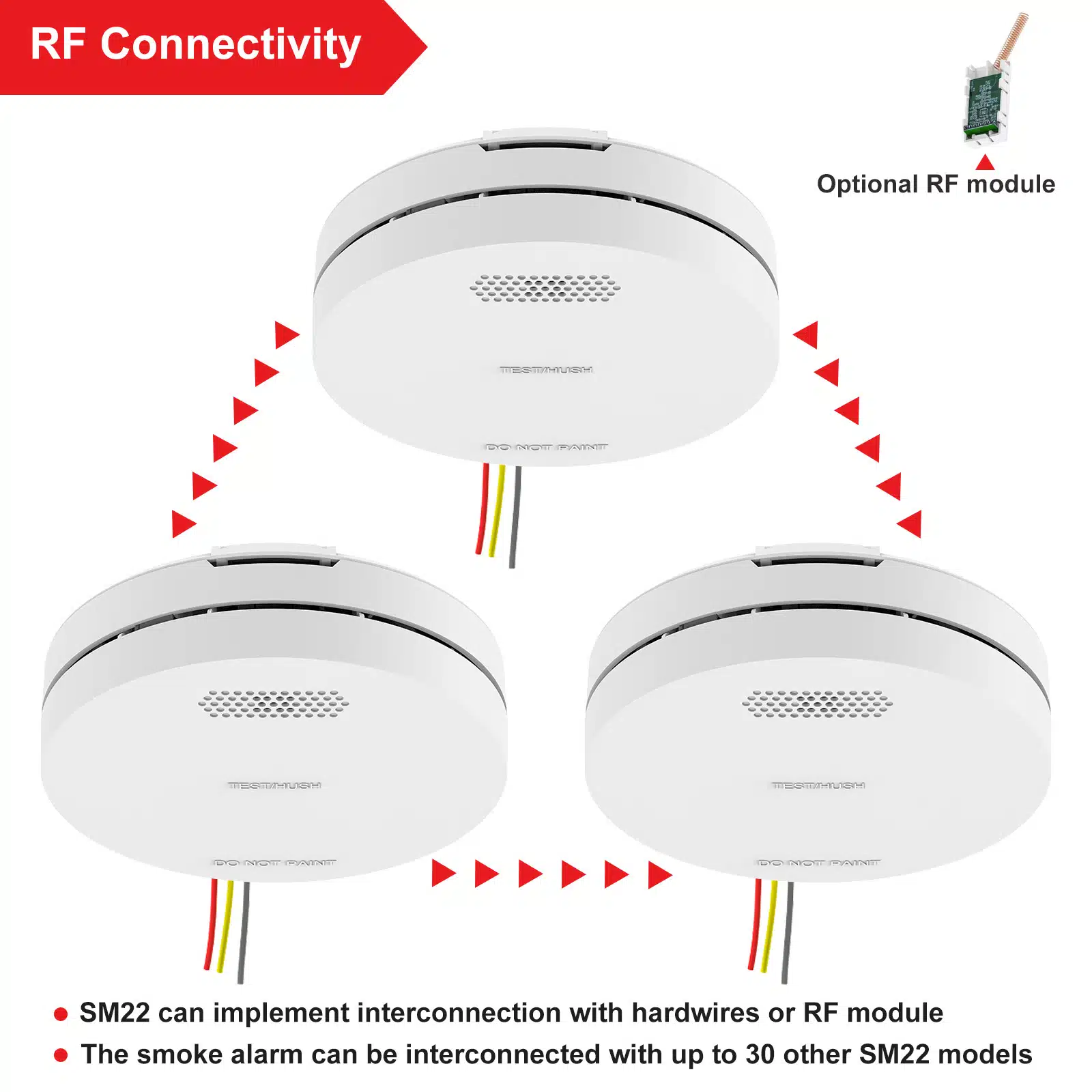
How RF Interconnection Works

Why Combine Hardwired Power with RF Interconnection?
Traditional hardwired wired-interlink and battery-only RF systems each carry unavoidable drawbacks; hardwired RF hybrid eliminates both pain points in one product.
Traditional Hardwired Limitations
RF-Only (Battery Powered) Limitations
Hybrid Solves Both Problems
Hardwired RF hybrid absorbs the strengths of both technologies while eliminating their defects:

Hardwired + RF vs Hardwired vs RF vs Wi-Fi
Feature | Hardwired Interlink | Battery-Only RF Alarm | Wi-Fi Smart Alarm | Hardwired + RF Hybrid |
|---|---|---|---|---|
AC Mains Power Supply | ✓ | × | Optional | ✓ |
Long-Life Backup Battery | ✓ (10Y Lithium Optional) | ✓ (1–2Y Alkaline) | ✓ | ✓ (10Y Sealed Lithium Standard) |
Wireless Offline Interconnection | × (Physical Cable Required) | ✓ | Optional (Relies on Internet) | ✓ (RF Works Without Router) |
Mobile Remote Notification | × | × | ✓ | Optional Add-On Wi-Fi Module |
New Construction Code Compliance | ✓ | × | ✓ | ✓ (Fully Meets Global Standards) |
Retrofit Installation Cost | Very High (Cable + Drywall Repair) | Low | Low | Medium (Balanced Hardware & Labor) |
Signal Penetration | Perfect | Good | Poor | Excellent |
Network Speed | Fast | Ultra-Fast | Slow | Ultra-Fast |
Maintenance Cost | Medium | Very High | Medium | Low |
Suitable Projects | New Build Only | Temporary Retrofit | Limited | New Build + Renovation |
Internet Dependency | None | None | Yes | Optional |
Future Expansion | Low | Medium | High | High |
Offline Operation | Excellent | Excellent | Limited | Excellent |
Smart Home Integration | Limited | Limited | Excellent | Optional |
Hardwired + RF hybrid alarms provide regulatory compliance, installation efficiency, long-term maintenance, and future expansion for new residential construction and multi-family projects.
Not sure which interconnection technology is right?
We’ll help you choose the best solution for your market and application.
Key Advantages of Hardwired + RF Hybrid Alarm Systems
Continuous AC Power with 10-Year Lithium Backup
Direct mains power eliminates low-battery fault chirps and weak RF signal failures common to battery-only detectors. Sealed lithium backup batteries deliver full detection and RF interlink performance for up to a decade without replacement, drastically cutting property management maintenance workloads.
Wireless Interconnection Without Extra Signal Wiring
No dedicated interlink cable installation required. Electricians only run standard AC power wiring to ceiling mounting positions, slashing construction labor hours, drywall damage, and post-installation repair costs — a critical cost-saving benefit for home builders and renovation contractors.
Fast Cross-Building Alarm Synchronization
RF broadcast technology triggers all paired alarms within milliseconds of hazard detection, ensuring residents on different floors or separate apartment units receive simultaneous evacuation warnings, critical for multi-unit residential fire safety compliance.
Lower Installation & Retrofit Costs
For a typical 4-bedroom residential retrofit, hardwired RF hybrid may reduce retrofit costs compared to traditional wired-interlink hardwired alarms, removing cable routes, wall cutting, and plaster repair fees. Builders reduce wall repair work on new housing developments.

Improved Reliability Compared with Wi-Fi-Only Systems
Wi-Fi alarms rely on home broadband routers; internet disconnection, router power failure, or metal wall shielding turns off cross-unit interlink entirely. Hardwired RF hybrid runs offline RF linkage independent of Wi-Fi networks, guaranteeing synchronized alarm response regardless of internet status. Projects requiring both remote phone alerts can add a separate Wi-Fi module without disrupting core RF offline safety function.
How Does a Hardwired + RF Alarm Work?
Normal Monitoring Mode
Under daily safe conditions, the MCU enters a low-power sleep cycle; the smoke/CO sensor samples air at preset intervals, and the RF module wakes briefly every few hundred milliseconds to scan the network signal. A steady green LED confirms normal AC power supply; the red LED blinks once every 40–48 seconds to indicate functional status without power waste.
Smoke or CO Detection Mode
When the sensor detects smoke particles or CO gas exceeding threshold values, the MCU instantly activates a local over 85 dB alarm sounder and red warning LED. The RF- and hardwire-interlinked transmitter immediately sends encrypted emergency broadcast signals to all detectors in the network.
Power Failure Operation
The built-in backup lithium battery automatically switches to supply power to the whole circuit, keeping it 100% operational without AC power.
Why Hardwired + RF Is More Reliable Than Wi-Fi-Only Alarm Systems
RF 433MHz vs 868MHz vs 915MHz: Which Frequency Should You Choose?
Frequency is determined by the radio regulatory compliance of the target market.
433MHz
868MHz (EU Standard ISM Band)
915MHz (North America Standard)
Procurement Checklist for Hardwired + RF Alarm Projects
Certification and Compliance Requirements
UL217 (North America Smoke Alarm Standard)
Mandatory for US & Canadian residential sales; defines performance requirements for mains-powered multi-station interconnected smoke alarms, including RF wireless interlink reliability, sensor sensitivity and backup battery discharge cycle testing. Hardwired RF hybrid units must pass full interlink synchronization failure simulation testing to obtain UL217 listing.
EN14604 (European Smoke Alarm Standard)
EU core residential smoke safety regulation; permits RF wireless interconnection systems and mandates simultaneous full alarm triggering when one detector activates. All hardwired RF models require CE marking + RED radio equipment compliance alongside EN14604 safety certification.
AS3786 (Australian Smoke Alarm Standard)
Australia’s mandatory fire safety standard for rental and new-build housing; recognizes mains RF hybrid interlink as a code-compliant alternative to hardwired signal cable systems, paired with ACMA radio spectrum approval for local RF bands.

UL2034 (Carbon Monoxide Detector Standard)
Applies to hardwired RF CO alarms; regulates electrochemical sensor lifespan, fault alert logic and cross-device RF interlink synchronization between CO and smoke detectors.
BS EN 50291 (EU CO Detector Standard)
European carbon monoxide monitoring safety standard, covering mixed RF network pairing of smoke + CO hardwired hybrid units.
NFPA 72 (US National Fire Alarm Code)
Sets installation rules for mains-powered interconnected alarms: dedicated fire circuit layout, mandatory backup battery requirement, full property interlink coverage for all bedrooms, hallways and every building floor — hardwired RF hybrid fully satisfies all NFPA 72 interconnection mandates without signal wiring.
Need certification documents for your project?
Request product certificates, test reports, and technical datasheets.
How to Choose a Hardwired + RF Smoke Alarm or CO Alarm
Verify Full Product Certification
Prioritize manufacturers holding complete target-market safety and radio certifications. Avoid uncertified generic models that will fail building inspections, customs clearance, and property tender qualification audits. Request full test reports including safety standard compliance and RF EMC/RED documentation before bulk order placement.
Choose the Correct RF Frequency Band
Match RF transceiver frequency to your export region’s ISM spectrum regulations. Mismatched frequencies lead to customs detention, signal interference, and inability to pass local fire safety inspections. Most OEM factories support firmware re-flashing to switch RF bands for different regional orders.
Confirm Interconnection Capacity
Large hotel, student dorm, and multi-floor apartment projects require supporting 40–50 paired devices per RF network. Smaller 24-unit maximum models are only suitable for single-family standalone homes; confirm network upper limit against your project floor plan layout.
Review Backup Battery Lifespan
For rental property and developer bulk projects, select sealed 10-year non-replaceable lithium battery variants to eliminate recurring battery replacement labor costs. Short-life replaceable 9V alkaline battery models are only suitable for small-scale private residential retail sales.
Evaluate OEM Customization Capability
Assess supplier’s ability to deliver full private-label solutions: laser engraving custom brand logo, tailored retail/engineering packaging, multi-language user manuals, adjustable alarm volume and hush timer firmware customization, plus optional external Wi-Fi module integration for smart property remote alert functions.
Procurement Decision Matrix
Project | Recommendation |
|---|---|
Single Home | Hardwired |
Apartment | Hardwired + RF |
Hotel | Hardwired + RF |
Rental | Hardwired + RF |
Smart Home |

Manufacturing Insight: How OEM Manufacturers Design Reliable Hardwired + RF Alarm Platform
Why Hybrid Platforms Are Becoming Mainstream for OEM Mass Production
Global OEM fire safety manufacturers are shifting from discrete single-function designs to unified hardwired + RF hybrid hardware platforms, driven by four core commercial & technical pressures:

Regional RF Frequency Design Built Into Base Platform Architecture
CFS designed the same motherboard for a 433MHz / 868MHz / 915MHz module to avoid separate circuit versions for each territory. Key design rules:
Hardware Platform Sharing: Modular Split Design to Maximize Common Parts
Leading OEMs adopt a core shared module + replaceable functional subassembly split for hardwired + RF hybrid platforms, splitting hardware into fixed universal sections and swappable market-specific sections:
1. Fixed Shared Core Modules (100% identical across all global SKUs)
2. Swappable Differentiated Sub-Modules (modified per market/SKU)
3. Manufacturing Line Compatibility Benefits
Assembly lines use identical main production fixtures for all hybrid variants; only small changeover jigs are required to swap sensor/RF subassemblies during mass runs. Factories can mix EU, US, and Asia order batches on the same production shift without full line shutdown, drastically improving production utilization for OEM bulk orders.
4. Quality Consistency Advantages
Since high-risk mains power and MCU circuits are standardized, factory IQC, aging tests, and reliability validation only need to run once on the core platform. Variants only require targeted RF/sensor performance spot checks, reducing mass production failure rates caused by inconsistent high-voltage circuit design.
Firmware Customization for Different Global Markets
The hybrid platform uses a single unified firmware codebase with segmented configurable parameter blocks, enabling OEMs to adjust regional compliance logic without rewriting core detection or RF interlink code. Key customizable firmware modules:
Engineering Considerations for Long-Term Field Reliability (10+ Year Service Life)
Hardwired + RF hybrid alarms are required to operate reliably for a full decade under variable temperature, humidity, mains voltage fluctuation, and EMI environments. OEM platform design embeds the following mandatory reliability engineering safeguards during R&D:
1. Dual Independent Power Domain Isolation
Separate power regulators for the high-voltage mains section, low-power MCU/sensor core, and RF radio module. If the RF chip short-circuits or draws abnormal current, the smoke detection circuit and backup battery power remain unaffected — eliminating complete system failure during RF hardware faults. All power switchover circuits undergo 10,000 simulated blackout-cycle aging tests during platform validation.
2. Low-Power Standby Optimization for 10-Year Lithium Lifespan
Even with continuous AC mains supply, the MCU enters nanoamp deep sleep for 99% of operational time to minimize backup battery self-discharge. RF wake-up duty cycles are hard-coded in firmware to staggered intervals (RF scan every 300ms, Wi-Fi sync only every 4 hours if fitted) to avoid simultaneous radio power spikes draining reserve battery during outages. Platform prototype reliability testing runs accelerated 10-year discharge environmental chambers to verify no premature low-battery faults.
3. RF Signal Stability Against Building Interference
4. Sensor Chamber Mechanical Durability Design
Modular optical/CO sensor housings use anti-dust labyrinth structures fixed to the shared PCB platform, preventing long-term dust accumulation that causes false alarms. All sensor assemblies pass 5,000 vibration cycle testing simulating building structural movement over years of occupancy.
5. Mains Surge & Overvoltage Protection
Integrated TVS diodes, fuse cutoffs, and varistors on the AC input circuit protect the entire hybrid platform from lightning surges and grid voltage spikes common in residential power grids. The design meets EN54-25 and NFPA72 surge immunity standards, a mandatory pass condition for all global fire safety certifications.
6. Batch Traceability Hardware Design
Every platform PCB reserves a unique serial number flash storage zone, factory-programmed with RF frequency band, production batch, sensor type, and OEM client brand code. If field reliability defects emerge, manufacturers can instantly isolate affected production lots without full mass recall — a core engineering requirement for large property developer OEM partners.
7. Environmental Aging Validation Mandates
Before mass platform launch, OEMs run continuous accelerated reliability testing:
Factory Quality Control for Hardwired + RF Alarms

Incoming Material Inspection (IQC)
100% key component inspection before warehouse release; only qualified materials enter the assembly line, with full batch traceability linked to production SN.
PCB Mainboard & RF Daughterboard
RF Communication Module (433/868/915MHz)
Smoke Chamber / CO Sensor
Backup Lithium / Alkaline Battery
Auxiliary Components
Mains terminal blocks, buzzer, LED indicators, plastic housing, mounting bases, and test buttons all pass dimension & appearance & electrical spot checks.
In-Line Functional Testing (100% Semi-Finished PCB Test)
All assembled core boards undergo full automatic functional fixture testing before casing assembly.
Smoke Detection Test
Simulate smoldering & flaming smoke aerosol; verify trigger threshold aligns with EN14604 / AS3786 / UL217, no delayed or false triggering.
CO Detection Test (Combo & CO Only Models)
Standard 0/150/400ppm CO gas injection; record response time, fault alert when sensor drifts.
RF Interlink Communication Verification (433 / 868 / 915MHz Separate Station Calibration)
Three independent RF test stations for regional frequency batches:
Test items per frequency:
Power Supply Automatic Switching Test (Core Hardwired RF Feature)
Simulate real mains blackout & power recovery cycles repeatedly:
Aging Burn-In Test (Semi-Finished Product Reliability Screening)
All fully assembled units enter a temperature-controlled aging room to expose early component failure before final inspection, with 24-hour continuous powered burn-in.
Aging environment parameters:
Aging failure screening targets:
All failed units are marked, isolated, and sent to engineering root cause analysis; zero defective flow to final packaging.
Final Inspection Before Shipment (OQC 100% Finished Goods Check)
After aging and cooling down, every single unit passes 4 groups of final verification before labeling & packing.
1. Full Appearance Inspection
2. RF Network Pairing Function Recheck
Manual pairing operation on production line test bench:
3. Full Alarm Performance Validation
4. Label & Marking Completeness Audit (Critical Customs & Code Compliance)
Mandatory label check items without omission:
Non-Conforming Product Control Rule
Any unit failing IQC / functional test/aging / final inspection will be:
Looking for a reliable OEM manufacturer?
Partner with CFS for certified products and stable production.
Best Applications for Hardwired + RF Alarm Systems

Single-Family New Homes
Ideal for residential builders; mains power meets local new-build codes, RF interlink removes expensive signal cable routing during construction.
Apartments & Condominiums
Perfect for both new apartment developments and older building retrofits; no wall demolition required to add cross-unit interlink functionality, lowering renovation tender costs for property developers.
Hotels & Serviced Accommodation
Scalable Interconnection network covers multi-floor guest room layouts; unified fire alert system simplifies hotel fire safety compliance audits.
Rental Properties & Landlord Housing Stock
Top choice for property management companies; minimal ongoing maintenance and full code compliance for local rental safety legislation.
Large Residential Development Projects (Builder / Developer Core Segment)
Mass-volume OEM supply for housing estates; standardized hardwired RF hardware cuts construction cycle time and unified safety system inspection pass rates.
Property Manager Exclusive Value Breakdown
Property management firms prioritize hardwired RF hybrid for three core operational benefits:
Common Installation Mistakes
Mixing Different RF Frequency Detectors in One Network
All installed detectors must share identical RF frequency bands from the same manufacturer series to avoid 433MHz, 868MHz, and 915MHz alarms mixing together.
Ignoring Backup Battery Maintenance Checks
Even 10-year lithium sealed models require annual function testing via the unit’s test/hush button. Property teams skipping periodic self-tests risk undetected dead backup batteries during long-term occupancy.
Poor Alarm Placement
Installing detectors lower than 3 meters in bathrooms, kitchens, ventilation fans, or ceiling light fixtures triggers frequent false alarms.
Installing Insufficient Interconnected Alarms
Many installers cut costs by fitting only 1–2 detectors per floor. Global fire codes require coverage in all sleeping areas and escape routes; incomplete RF network layout leads to failed building sign-off inspections.
Connecting hardwired RF alarms to shared household lighting circuits risks accidental power shutoff via wall switches, violating mandatory dedicated fire circuit regulations.
CFS Hardwired + RF Solutions
Hardwired RF Smoke Alarm Series
SM22 and SM21 with 10-year lithium backup batteries comply with EN14604 / AS3786 and support 433/868/915 MHz frequency customization.

Hardwired RF Smoke + CO Combo Alarm Series
Dual-function integrated smoke & carbon monoxide hybrid hardwired RF detector, single-unit solution to reduce installation quantity and hardware costs for property projects, mixed RF network compatible with standalone smoke/CO units.
Hardwired RF Standalone CO Alarm Series
Mains-powered carbon monoxide monitors with RF interlink, dedicated electrochemical CO sensor, compliant with UL2034 and BS EN 50291 for multi-unit residential gas hazard protection.
OEM and ODM Customization Solutions
Ready to build your Hardwired + RF product line?
Contact CFS for OEM, ODM, and certification support.
FAQ
Q1 Can Hardwired + RF smoke alarms and heat alarms be interconnected?
Yes. Smoke, combo smoke and CO, and CO and heat alarms can be mixed in one Interconnection. Any triggered unit will sync all alarms instantly. The unified RF interlink protocol meets NFPA72, EN14604 and AS3786 for apartments & houses.
Q2 Can different brands of RF alarms communicate together?
No, most cross-brand RF alarms fail interconnection. Brands use unique encrypted RF signals that other devices can’t read. Only identical OEM hardware with shared encryption keys can pair. Buy same-series alarms for full sync safety.
Q3 Can Hardwired + RF alarms be upgraded to Wi-Fi later?
Yes. The platform reserves detachable Wi-Fi daughterboard slots. Install pre-production or retrofit on-site. Wi-Fi enables mobile alerts & cloud management, while offline RF linkage still works without internet.
Q4 What is the maximum RF communication distance?
433MHz /868MHz/915MHz open space reaches 90–150m. Interconnection relays signals via other detectors to cover large multi-floor buildings.
Q5 Do Hardwired + RF alarms require regular RF testing?
Yes, regular RF testing is code mandated. Home users test monthly; property teams test quarterly. Press one test button to check full sync. Replace weak batteries or reposition units if signal failure occurs.
Q6 Can Hardwired + RF alarms be connected to fire alarm control panels?
Yes. Built-in dry contact relay terminals connect to commercial fire control panels. Triggered alarms send signals to central monitoring systems, suitable for hotels, dorms, and large residential compounds. Custom relay logic is available for OEM.
Q7 How are Hardwired + RF alarms tested before shipment?
Full factory QC covers 6 steps: IQC component check, smoke/CO/RF/power function test, 24/48h aging burn-in, final appearance & pairing recheck, label audit, pre-loading random sampling. Defects are isolated before shipment.
Q8 What documents should OEM buyers request before mass production?
Buyers need 6 docs: safety/RF certification reports, full technical specs & manuals, OEM packaging/logo confirmations, ISO9001 certificate, raw material reliability test records, quotation, warranty and after-sales support agreement.
Q9 What is a hardwired RF smoke alarm?
Hardwired RF smoke alarms are mains AC-powered fire detectors with built-in RF wireless modules that enable cable-free cross-unit alarm synchronization when smoke is detected.
Q10 How does RF interconnection work on hardwired alarms?
All paired units form a closed Interconnection network; one triggered detector broadcasts radio signals, and every linked alarm sounds simultaneously without signal wiring.
Q11 Can RF interlink operate without Wi-Fi internet?
Yes, RF communication runs fully offline, independent of routers and broadband; interlink functionality remains active during complete internet outages.
Q12 Which RF frequency band is better, 433MHz or 868MHz?
433 MHz is suitable in Asia/Middle East/Australia, and 868 MHz is used in EU & UK markets.
Q13 Are hardwired RF alarms legally required by building codes?
Mains-powered interconnected alarms are mandatory for all new residential construction in the US, EU and Australia; hardwired RF hybrid is fully accepted as compliant interlink technology by all major safety standards bodies.
Q14 Are hardwired RF alarms suitable for apartment renovation retrofits?
They are the top retrofit solution; no interlink cable routing or wall cutting required, slashing renovation labor and repair costs by over 70%.
Q15 Do hardwired RF detectors support OEM private label customization?
CFS supports full ODM/OEM service, including custom logos, packaging, and multilingual manuals.
Q16 How frequently do backup lithium batteries need replacement?
Sealed 10-year lithium battery models require zero replacement for the full decade service life; replaceable alkaline variants need annual inspection and 1–2 year swap cycles.
Q17 Are hardwired RF hybrid systems more reliable than Wi-Fi-only smart alarms?
Yes. RF offline linkage avoids internet/router failure risks, meets all offline fire safety code requirements, and eliminates recurring cloud service fees for property operators.
Q18 Can Hardwired + RF smoke alarms support mixed smoke, heat and CO alarm networks?
Yes. The hybrid RF system supports mixing smoke, heat, CO, and combo alarms. Triggering any unit sends RF signals to all linked devices to trigger simultaneous alarms, fully complying with global residential fire safety codes.
Q19 Can OEM buyers customize RF frequencies for different countries?
Yes. OEMs reflash firmware and swap matching RF chips at 433/868/915 MHz. Hardware PCB remains unchanged, matching radio regulations in Asia, the EU, North America, and Australia separately.
Q20 Can one hardware platform support multiple certifications?
Yes. One unified hardware platform passes UL217, EN14604, AS3786 and related RF certifications. Only the firmware and minor RF components are adjusted to meet different regional test standards.
Q21 What is the normal OEM lead time?
Sample lead time:7–14 days for customization. Mass production lead time:25–30 working days, depending on order quantity, certification requirements, and custom private label packaging.
Q22 How can distributors verify certification authenticity before placing an order?
Request original test reports, certification files, and authority inquiry links. Cross-check certificate numbers on official UL/CE/ACMA websites and audit factory test records to avoid fake certification documents.


